

Market Fundamental Analysis
Federal Reserve policymakers resumed public appearances with a distinctly hawkish tone following the end of their blackout period. Having delivered their first 25 bps rate hike in three years to 3.75%-4.00% last week, officials amended their statement by deleting references attributing recent inflation to supply shocks, retaining only that inflation remains elevated. On September 22, Chicago Fed President Austan Goolsbee emphasized that persistent supply shocks cannot be overlooked, while St. Louis Fed President Alberto Musalem asserted that additional rate increases may be required to steer inflation back to target. Institutional projections regarding the terminal rate are diverging: Goldman Sachs and Mizuho lean toward a pause after a December hike, Société Générale and Danske Bank project 25 bps hikes in both December and March 2027, and Bank of America warned rates could exceed 5.00%.
International energy benchmarks plunged over 9% across four consecutive trading sessions, offering marginal relief to energy-driven inflation anxieties and briefly sparking a morning rebound in bullion. Brent crude retreated steadily from last week's highs near $108/barrel as repair progress on Saudi Arabia's East-West pipeline and prospects for Middle East diplomatic mediation compressed geopolitical risk premiums. While declining energy inputs theoretically lessen the urgency for Fed rate hikes, markets remain concerned that the disinflation pace will be insufficient to derail the tightening path, keeping the US Dollar Index firm near 100.4 and bond yields elevated.
President Trump is scheduled to address the UN General Assembly on Tuesday and expressed openness to meeting Iranian President Pezeshkian, fueling diplomatic de-escalation expectations and compressing safe-haven risk premiums. While Houthi drone and missile strikes against sensitive targets near Riyadh lifted geopolitical caution over the prior weekend, the emergence of a potential diplomatic opening prompted traders to re-evaluate the probability of broader escalation. Tangible progress in Middle East diplomacy would improve regional energy transit security and further dampen inflation expectations, directly undercutting gold's geopolitical bids and contributing to the stalled precious metals rally on September 22.
Gold Technical Analysis
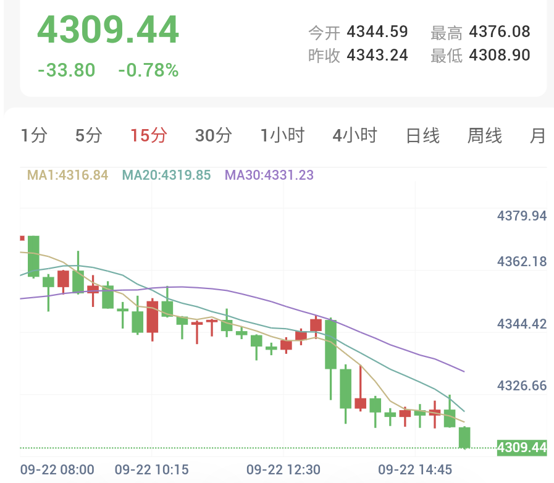
Daily Framework: Spot gold opened at $4,344.59/oz during today's Asian session, initially ticking higher before retreating to register a high of $4,376.08 and a low of $4,308.90, currently trading near $4,309.44/oz (-0.78%). Daily moving averages maintain a golden cross configuration, preserving the broader bullish outlook. Price action remains wedged between the 20-day and 80-day moving averages, warranting patience for a sustained daily close above the 20-MA before adding trend-following long exposure. Crucial psychological support resides at $4,300, where buyers must demonstrate stability.
Intraday Short-Term (15-Minute): Moving averages display a clear bearish alignment, with price consolidating underneath the 15-minute 20-MA at $4,319.85. Traders should monitor pullbacks toward the 20-MA for tactical short entries; a corrective test into the $4,319–$4,325 resistance zone with topping signals offers an entry reference, anchored by a stop-loss above $4,376.08 and targeting a 2:1 risk-reward objective. A sustained recovery above $4,320 warrants stepping aside to observe.
Silver Technical Analysis
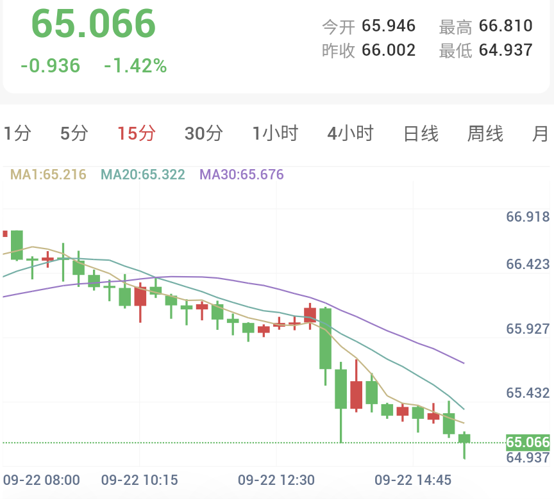
Daily Framework: Spot silver opened at $65.946/oz today, oscillating within an intraday high of $66.810 and a low of $64.937, currently changing hands near $65.066/oz (-1.42%). Daily moving averages preserve a golden cross with a constructive bias. Having previously breached above the daily 20-MA, the $66.246 level serves as an advantageous reference for medium-term longs, with stop-losses positioned beneath the cyclical low at $62.300.
Intraday Short-Term (15-Minute): The 15-minute moving average structure remains bearish, with price tracking significantly beneath the 20-MA ($65.322). Tactical traders should await mean-reversion pullbacks toward the 20-MA; rejection within the $65.300–$65.400 resistance pocket presents potential short setups with risk defined above $66.810, targeting a 2:1 risk-reward ratio. A confirmed breakout back above $65.400 invalidates short setups and calls for a neutral stance.
Risk Warning
Trading markets involve unpredictable risks, including but not limited to the loss of principal. This analysis is for reference only and does not constitute direct investment advice. Investors must conduct independent evaluations and make decisions aligned with their personal risk tolerance.