

Houthi Strikes on Saudi Arabia Push Gold Below $4,400 Level

1. News & Geopolitical Events
On Tuesday, conflict in the Middle East broadened significantly, directly impacting regional energy infrastructure:
• Houthi Forces Strike Saudi Heartland: Yemen's Houthi movement launched attacks targeting multiple cities and critical energy facilities across Saudi Arabia. A coalition spokesman confirmed that the strikes left at least 73 people injured across four southern cities, sparking fires at several energy sites.
• Iran Reaffirms Maritime Exclusion Zone: Mohsen Rezaee, Secretary of Iran's Supreme National Security Council, issued warnings on social media asserting that recent ballistic missile launches conveyed a clear signal to Washington. He reiterated that Iran will establish a maritime exclusion zone across the Persian Gulf to counteract economic warfare, fundamentally altering its operational posture toward U.S. warships and bases.
• Benchmark Energy Commodities Climb: Spurred by the strikes against Saudi energy assets and mounting transit disruptions across shipping corridors, global energy prices surged to their highest levels in over six weeks.
• Official U.S. Statements: Former President Donald Trump posted on social media that fuel prices would decline sharply once the U.S. resolves the conflict, reaffirming a commitment to prevent Iran from obtaining nuclear weapons.
2. 30-Minute Candlestick Chart Analysis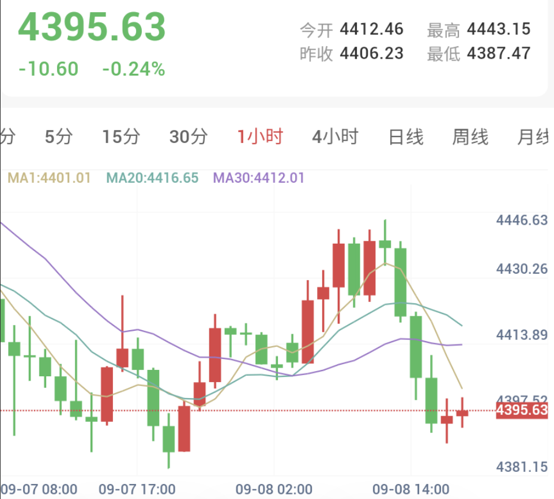
As of 17:24 Beijing time, spot gold traded at $4,395.63/oz, down 0.24% (-$10.60) intraday, having relinquished the key $4,400 psychological benchmark.
Gold previously mounted an intraday advance driven by short-term buyers, reaching an interim peak of $4,443.15. However, overhead supply intensified as surging energy costs reinforced macro inflation headwinds. Consecutive large bearish candles produced a steep vertical slide, decisively piercing the $4,400 defensive line to establish an intraday low of $4,387.47.
Across moving averages, the preceding bullish alignment was dismantled by the abrupt price drop. The MA1 ($4,401.01), MA20 ($4,416.65), and MA30 ($4,412.01) were decisively breached and have begun rolling downward, transforming into dynamic overhead resistance zones.
3. 30-Minute Technical Indicators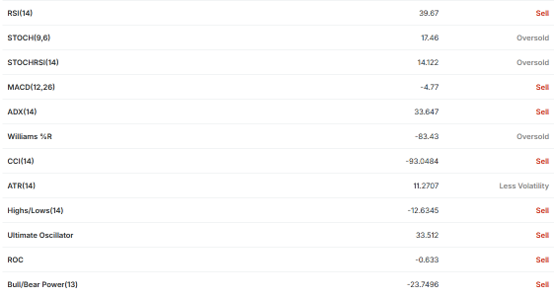
Following an intraday plunge exceeding $50 from its high, the 30-minute technical indicator composite registered a definitive "Strong Sell" rating (0 buy, 0 neutral, 8 sell), with bears firmly in control while several sensitive oscillators entered deep oversold territory:
• Trend and Momentum Indicators Align Bearish: The intermediate MACD(12,26) printed at -4.77, maintaining sell signals. The ADX(14) trend strength metric recorded 33.64 with a sell indication, confirming strong trend persistence. The RSI(14) stood at 39.67, held below the neutral 50 centerline within bearish territory.
• Short-Term Oscillators Deeply Oversold: The STOCH(9,6) printed at 17.46, the fast StochRSI(14) registered at 14.12, and the Williams %R stood at -83.43, all settling into extreme oversold bands.
Indicator confluence confirms that the short-term bearish breakdown structure remains established under macro tightening pressure. However, extreme oversold readings after touching $4,387.47 suggest concentrated selling exhaustion, introducing the possibility of a technical pause or a relief test back toward the $4,400 threshold.
4. Summary
Overall, direct strikes on Saudi energy facilities by Houthi forces and threats of an Iranian maritime exclusion zone heighten the risk of physical energy supply interruptions. Escalating oil prices elevate inflation concerns, reinforcing expectations that the Federal Reserve and global central banks will sustain restrictive interest rates. Under the macroeconomic weight of higher energy costs feeding persistent inflation and tighter monetary policy, non-yielding gold faces sustained carrying cost pressures, resulting in a breakdown of bullish defenses.