

Middle East Shipping Risks Escalate as Hot PPI Drives Fed Hike Bets Ahead of CPI
1. Gold Rebounds Marginally After Dropping to One-Week Low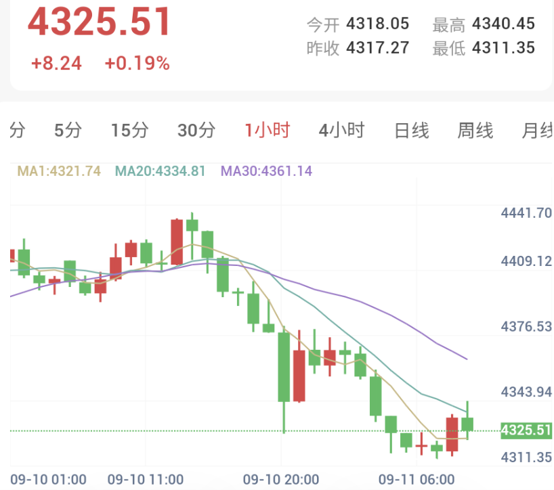
During the Asian session on September 11, spot gold staged a minor recovery following sharp declines in the previous session. As of 09:58 Beijing time, gold traded at $4,325.51/oz, up $8.24 or 0.19% intraday, having opened at $4,318.05 with a high of $4,340.45 and a low of $4,311.35.
Gold dropped nearly 2% in the prior session, touching an intraday low of $4,313.58 before closing near $4,316, marking a fresh one-week low. Entering Friday, gold briefly climbed above $4,340 before gains moderated, continuing to hover near the $4,320 level.
On the 1-hour chart, the MA20 lies near $4,334 and the MA30 sits near $4,361, indicating that bullion has not yet shaken off recent downward technical pressure.
2. Houthi Forces Advance Toward Bab el-Mandeb as Regional Hostilities Escalate
In the Middle East, fresh signs of tension have emerged simultaneously across the Red Sea and the Strait of Hormuz.
Reports indicate that Yemeni Houthi forces seized control of the strategic Red Sea port of Mokha and advanced southward along the coastline toward the Bab el-Mandeb strait. Yemeni government forces and their allies have attempted to hold key areas such as Dhubab, intensifying the battle over the southern entrance to the Red Sea.
Concurrently, naval standoffs between the US and Iran near the Strait of Hormuz remain unresolved. Following earlier US actions against Iranian maritime assets, the IRGC issued renewed warnings. Simultaneous conflict along two crucial shipping corridors has revived market concerns over further contractions in regional energy transit.
3. Hotter US August PPI Lifts Rate Hike Probabilities to Around 70%
Beyond geopolitical friction, the latest US inflation data served as the primary catalyst for Thursday's gold decline.
US August PPI rose 0.4% MoM, with the annual rate accelerating to 5.4%. Energy items climbed 4.2% MoM, ending two consecutive months of declines, while core goods prices rose 1.1% overall.
Services prices also expanded, with airline passenger fares jumping 4.2% MoM, truck transportation costs up 2.0%, and outpatient and inpatient hospital care increasing 0.4% and 0.5% respectively. Because several of these components feed directly into PCE inflation, market concerns over persistent US price pressures surged.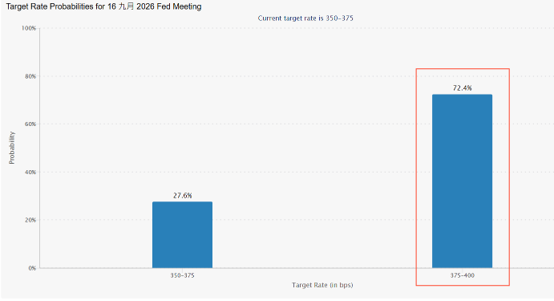
Following the release, CME FedWatch indicated market-implied odds for a 25 bps Fed rate hike in September increased from approximately 62% to 72.4%.
4. US Treasury Yields Surge Sharply
Shifting policy expectations transmitted rapidly into the US debt market. The benchmark 10-year Treasury yield rose to the 4.92%–4.95% band, the 2-year yield extended higher, and the 30-year yield approached highs last observed in 2007.
Gold had previously mounted a rebound on easing long-term yields, but the confluence of rising energy costs, strong PPI figures, and resilient jobs data prompted markets to price in a prolonged period of higher interest rates.
Against this backdrop, gold retreated sharply from above $4,400, breaking through $4,380, $4,350, and $4,320 in quick succession.
5. Tonight's CPI Print Serves as the Decisive Catalyst
With the PPI released, market focus has pivoted entirely to the US August CPI report.
The macro backdrop confronting gold is straightforward: strong August payrolls, rising producer pipeline inflation, and escalating energy costs driven by Middle East conflict. CPI represents one of the most critical inputs ahead of the September 15–16 FOMC meeting.
A hotter-than-expected CPI could further solidify rate hike expectations, whereas a cooler reading could ease the relentless upward pressure exerted by Treasury yields.
Market Outlook
As of 09:58 Beijing time, spot gold has recovered from its intraday low of $4,311.35 to trade near $4,325.51, though it remains confined to recent low-water marks.
Overhead resistance lies first near $4,340, followed by the $4,360–$4,380 zone. On the downside, support is watched at $4,310 and the $4,300 psychological boundary.
Today's primary market mover will be the US CPI release. Meanwhile, developments in the Red Sea, shipping flows through Hormuz, and US-Iran military actions will continue to dictate energy prices and monetary policy expectations.