

The focal point of the upcoming Federal Open Market Committee meeting is not whether policymakers will hold rates steady, but how Fed Chair Kevin Warsh characterizes the recent inflation rebound and whether he outlines criteria for future policy tightening.
Financial markets have largely discounted an October pause; marginal volatility following the announcement will stem primarily from forward guidance within the policy statement and Warsh's press conference.
I. Decision Outlook: Pause Odds Dominate, Yet Hawkish Tail Risks Persist
The FOMC gathers for its scheduled monetary policy meeting on October 27–28, with the interest rate decision due at 2:00 PM EDT on October 28, followed by Chair Warsh's press conference at 2:30 PM EDT. Official schedules confirm a standard two-day session.
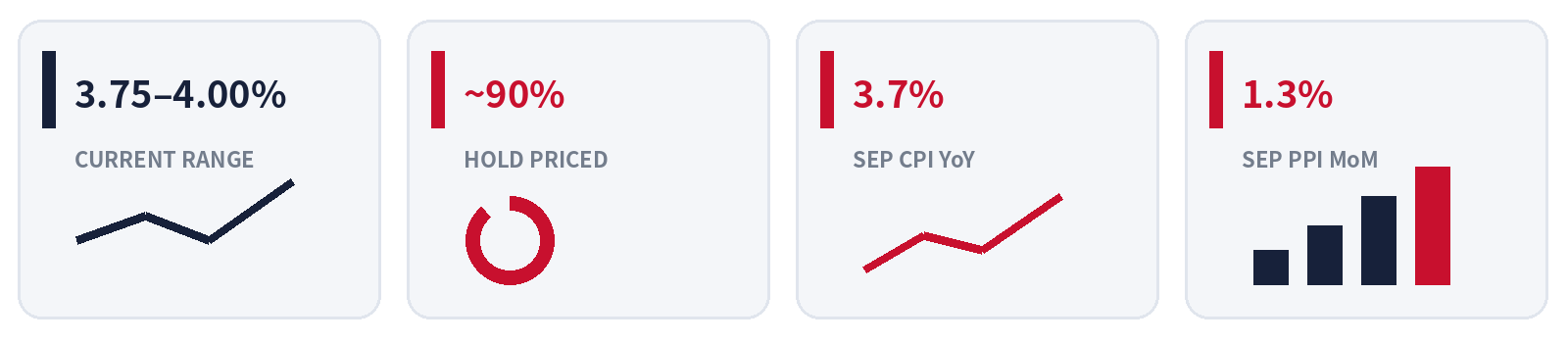
After raising the target range for the federal funds rate by 25 basis points to 3.75%–4.00% in September, rate futures currently imply an 88% to 90%+ probability of holding the policy rate unchanged in October.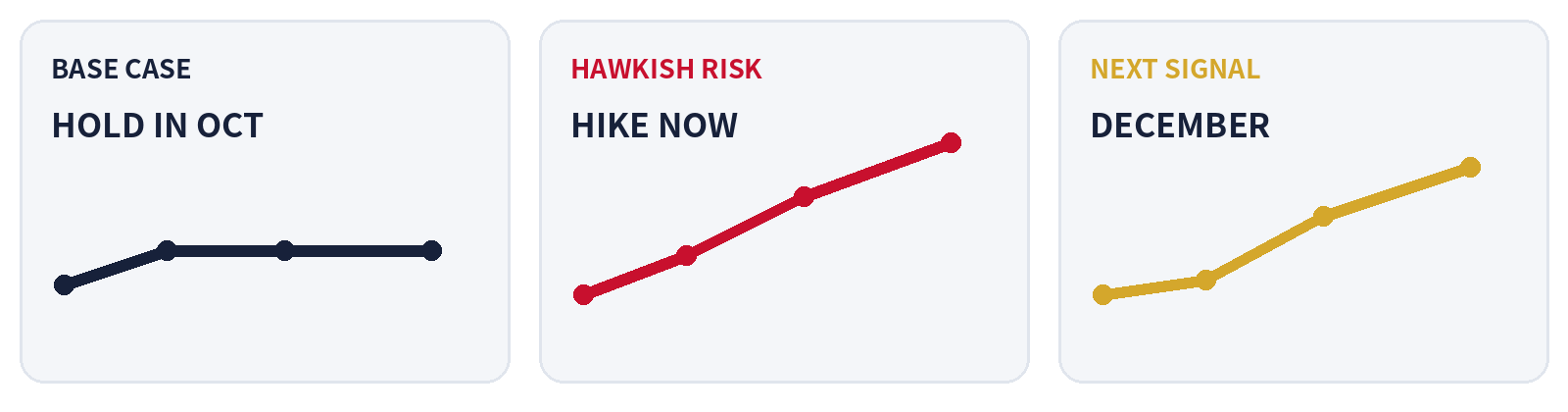
The argument for pausing centers on labor dynamics: September nonfarm payrolls rose by just 29,000, the unemployment rate ticked up to 4.2%, and historical revisions subtracted a net 60,000 jobs across July and August, indicating thinner labor market buffers. Enacting back-to-back rate hikes also risks premature overtightening.
Conversely, the case for hiking immediately rests on elevated price data: September CPI advanced 0.6% MoM and final demand PPI jumped 1.3% MoM, confirming that upward price pressures are broadening across upstream goods and services alongside energy spikes. Some economists argue that delaying until December risks falling behind the curve.
Consequently, the baseline outcome favors keeping rates steady at 3.75%–4.00% while preserving optionality for further tightening. Should Warsh avoid explicit guidance, market participants will scrutinize his commentary on price persistence and financial conditions to gauge the threshold for a December hike.
II. Inflation Dynamics: CPI and PPI Heat Up as Energy Shocks Spread
Headline US September CPI gained 0.6% MoM and climbed to 3.7% YoY, while core CPI rose 0.3% MoM to 2.6% annualized. Gasoline costs surged 9.1% and the broader energy index advanced 5.2%, with fuel accounting for over half of headline CPI expansion.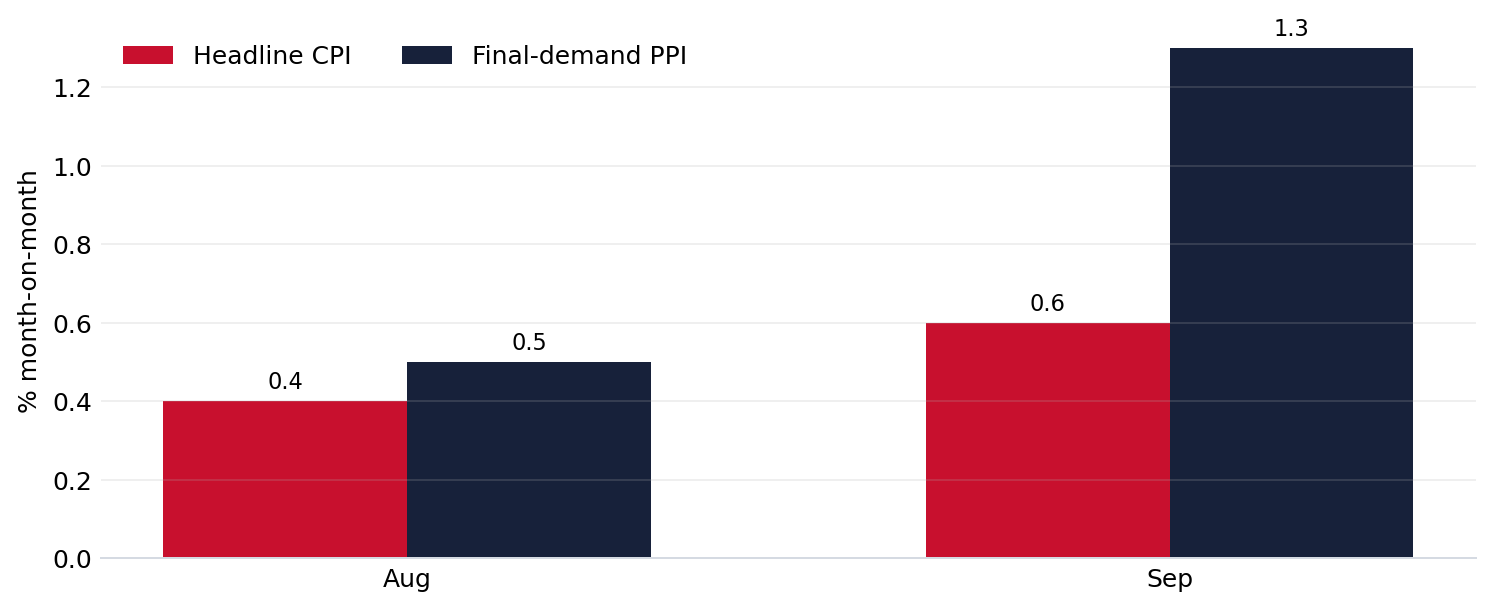
Upstream wholesale metrics present a more acute concern. Final demand PPI surged 1.3% MoM—its steepest monthly increase since March 2022—to reach 6.3% YoY, driven by a 2.6% gain in goods and a 0.8% rise in services. Widespread PPI gains indicate that cost pressures are filtering directly into production and retail channels.
Simultaneously, Middle East tensions and maritime transport hazards in the Strait of Hormuz keep oil markets elevated. Brent crude touched $116.72 per barrel on October 23, and despite a modest pullback, trades near $115 per barrel. Sustained energy strength not only lifts headline gauges directly but also threatens to spill over into broader core price structures.
The Federal Reserve's formal mandate targets Personal Consumption Expenditures (PCE) inflation. The September PCE report is scheduled for release on October 29, the day after the FOMC decision. Consensus projections expect headline PCE to reach 3.6%–3.7% YoY and core PCE near 3.1%. With official data pending, the committee must evaluate underlying PCE risks solely through CPI and PPI breakdowns.
III. Employment and Growth: Labor Market Cools While Real Demand Faces Constraints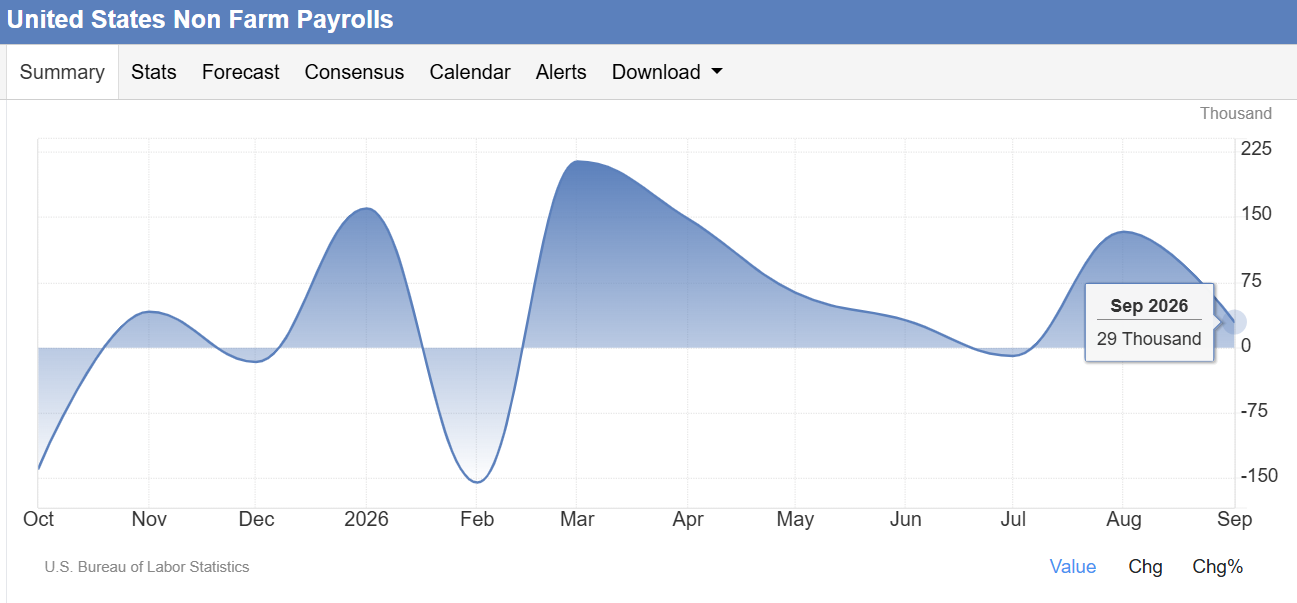
Labor indicators reflect growing fragility. September payrolls increased by only 29,000, unemployment reached 4.2%, and previous monthly estimates were revised down significantly (July to -10,000 and August to 133,000). While average hourly earnings growth moderated to roughly 3.0% YoY, cooling employment trends complicate the Fed's dual mandate.
While the labor market is not in freefall, sharp downward revisions suggest hiring momentum is waning, heightening the risk that further tightening could accelerate economic contraction even as energy costs strain household finances.
Consumer spending figures also require careful parsing. September retail sales rose 0.8% MoM, but growth was heavily skewed by gasoline station receipts. The core retail control group—which feeds directly into GDP calculations—expanded by a modest 0.1%, underscoring that nominal gains largely reflect fuel inflation rather than robust underlying demand.
Furthermore, advance Q3 GDP figures, September PCE data, and personal spending metrics will be published on October 29, ensuring that subsequent macro prints will swiftly recalibrate expectations for the December FOMC meeting.
IV. Policy Communication: Warsh Expected to Signal a Hawkish Pause Ahead of December
Since the September rate increase, Chair Warsh has adopted a data-dependent, measured communication style. With markets seeking clarity on the terminal policy rate, his press conference performance will be pivotal.
If rates remain unchanged, Warsh must articulate why the committee paused despite hot CPI and PPI prints. A defensible policy rationale would emphasize that current interest rates are already restrictive, labor metrics have moderated, and PCE figures remain pending, framing the pause as an observational phase rather than an end to tightening.
Market participants will focus on four specific narrative cues:
1. Whether the September inflation acceleration is categorized as a transient energy shock or a structural risk;
2. Whether current policy rates are deemed sufficiently restrictive to curb demand;
3. How officials interpret labor revisions—whether as statistical noise or a definitive cooling signal;
4. Whether Warsh establishes concrete economic hurdles for a December rate hike.
Ahead of the US midterm elections, political scrutiny over borrowing costs and inflation remains intense. The committee's most prudent path is to anchor communication strictly to its dual mandate and incoming data, insulating monetary policy decisions from political narratives.
(Compiled and Edited by Lucky Gold Global Limited)
Fed October Meeting Preview: As Inflation Reaccelerates, Will Warsh Pause or Hike Early?
Published: 2026-10-26 10:23:40