

I. Gold Consolidates Near Converging Averages, Pre-FOMC Dip-Buying Limits Downside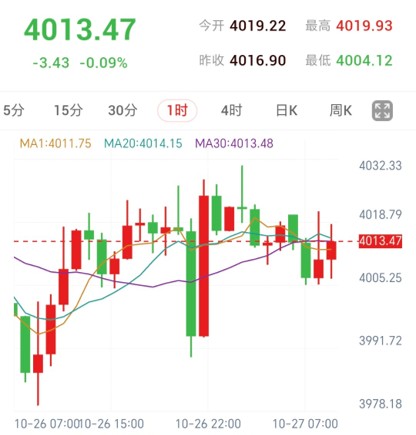
On October 27, London gold traded at $4,013.47 per ounce, down $3.43 or 0.09% from the previous close.
The session opened at $4,019.22 following yesterday's close at $4,016.90, posting an intraday high of $4,019.93 against a low of $4,004.12.
Following an overnight technical recovery driven by dip-buying, bullion eased marginally as market focus shifted toward this week's Federal Reserve rate decision and subsequent key inflation metrics.
Across the 1-hour timeframe, moving averages are tightly clustered:
MA1 stands at $4,011.75
MA20 stands at $4,014.15
MA30 stands at $4,013.48
Price currently trades above MA1, marginally below MA20, and directly against MA30, while RSI(14) registers at 50.15 in neutral territory.
Tightly converging averages alongside neutral momentum indicate that near-term price action remains within a rotational consolidation phase, with the intraday range boundaries ($4,019.93 and $4,004.12) defining immediate directional watchpoints.
Sustaining a 1-hour close above this moving average cluster remains the primary technical benchmark for evaluating rebound durability.
Gold rebounded on October 26 from a three-month trough. Bob Haberkorn, Senior Market Strategist at StoneX, noted that softer energy prices offered underlying support to bullion alongside opportunistic dip-buying, though he expects trading volumes to remain subdued ahead of the Fed's policy statement as investors await official forward guidance.
II. October Pause Widely Discounted, December Rate Hike Probability Touches 80%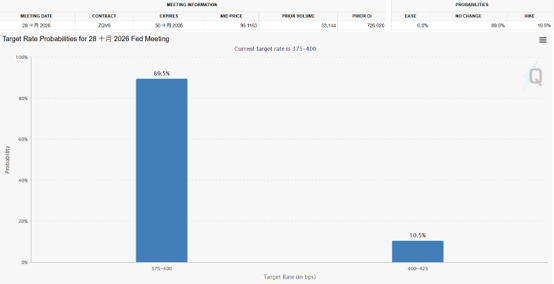
The Federal Open Market Committee (FOMC) will release its scheduled rate decision on October 28 local time.
While market participants overwhelmingly anticipate that the central bank will keep rates steady at 3.75%–4.00% following its September hike, bets on additional year-end policy tightening remain firmly elevated.
CME FedWatch data indicates that as of October 26, traders priced the probability of a December rate hike at approximately 80%.
Gennadiy Goldberg, Head of US Rates Strategy at TD Securities, stated that he expects the Federal Reserve will resume rate hikes in December.
With an October pause heavily discounted, the policy statement and Chair Kevin Warsh's post-meeting press conference will take center stage, with allocators examining official commentary on energy prices, recent hot inflation readings, and forward tightening hurdles.
Gold remains caught in a tug-of-war ahead of the meeting: defensive low-level buying provides a floor, while lingering expectations of year-end tightening continue to cap recovery headroom.
Should the policy statement reiterate persistent inflation risks, bullion's recovery will face headwinds; conversely, greater emphasis on growth moderation and financial market volatility would prompt markets to re-evaluate the scale of future tightening.
III. Crude Benchmarks Ease on Diplomacy, Long-Term Supply Vulnerabilities Linger
According to a Reuters energy market report, international benchmark crude settled down 0.8% at $115.81 per barrel on October 26, while US crude futures fell 1.46% to $101.76 per barrel.
Intensive Middle Eastern diplomatic talks injected temporary de-escalation hopes that prompted profit-taking off multi-month peaks, though energy benchmarks remain anchored near six-month highs.
Crucially, critical energy infrastructure and maritime shipping lanes remain vulnerable to ongoing regional friction.
International Energy Agency (IEA) Executive Director Fatih Birol observed that global energy markets are unlikely to return to their pre-conflict equilibrium before 2027.
While gold's overnight bounce coincided with easing fuel prices, persistent supply chain risks and commodity premiums will continue to influence headline inflation expectations and market sentiment.
IV. Tehran Diplomatic Talks Advance as Air Defense Interceptions and Warnings Persist
On the geopolitical front, senior officials from Saudi Arabia, Turkey, and Pakistan met with Iranian counterparts in Tehran on October 26 in an effort to prevent further regional escalation.
Concurrently, Qatari mediators arrived in Tehran to facilitate communication, with diplomatic engagement generating hopes for temporary stabilization.
However, military friction across the theater has not ceased.
Yemeni Houthi forces claimed strikes on pumping stations along Saudi Arabia's East-West pipeline and Riyadh's international airport, while the Saudi-led coalition reported intercepting and destroying three incoming drones over Riyadh and southern sectors.
Egypt's parliament officially authorized the president to undertake defensive measures to assist Saudi Arabia if requested, while Iranian security officials issued warnings of prospective retaliatory strikes targeting Gulf undersea communication cables should US or Israeli strikes recur.
The parallel progression of diplomatic dialogue and regional strikes continues to trigger episodic swings in bullion safe-haven flows.
V. US Dollar and Treasury Yields Anchor Higher, Big Tech Earnings Come into Focus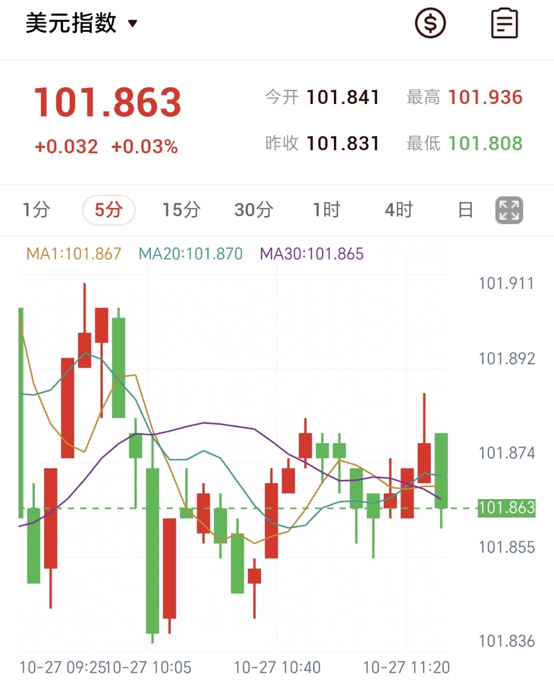
In currency and fixed income markets, the US Dollar Index advanced 0.26% overnight to settle at 102.02, while the benchmark 10-year Treasury yield held near 4.988%, the 30-year yield touched 5.3%, and the 2-year yield rose to 4.714%.
A resilient greenback and elevated sovereign yields continue to act as counterweights against pre-decision dip-buying in gold.
Across equities, previous tech volatility drove safe-haven inflows into government debt; attention now turns to quarterly earnings reports from mega-cap tech corporations, including Microsoft, Alphabet, and Amazon.
Capital expenditure guidance surrounding artificial intelligence and the equity market's subsequent reaction will continue to steer multi-asset rotations across stocks, Treasuries, and bullion.
VI. Core PCE Report Follows FOMC as Midterm Elections Approach
Directly following the Federal Reserve's policy announcement, the US Personal Consumption Expenditures (PCE) price index for September is scheduled for release on October 29.
As the Fed's primary inflation gauge, the print will provide critical guidance regarding the December policy path: a resilient reading would cement tightening bets, whereas a softer print would allow markets to reassess the necessity of further rate hikes.
Additionally, the upcoming US midterm elections on November 3 have begun entering market calculations, with participants gauging prospective fiscal and regulatory shifts.
In the near term, gold remains positioned between the FOMC rate decision and the PCE print; against evolving Middle East diplomacy and geopolitical risks, official policy language and inflation trajectories will dictate bullion's next directional breakout.
(Compiled and Edited by Lucky Gold Global Limited)
Fed Decision Looms as December Hike Bets Near 80%, Gold Pulls Back Post-Rebound
Published: 2026-10-27 11:54:43