

August 2026 Non-Farm Payrolls Preview
Can Employment Escape Contraction?

Core Focus:Was July's contraction merely a short-term blip? If August only sees a modest rebound, the unemployment rate, wage growth, and revisions to prior data will be far more important than the headline payroll number itself.
1. Introduction: A Crucial Test After July's Contraction
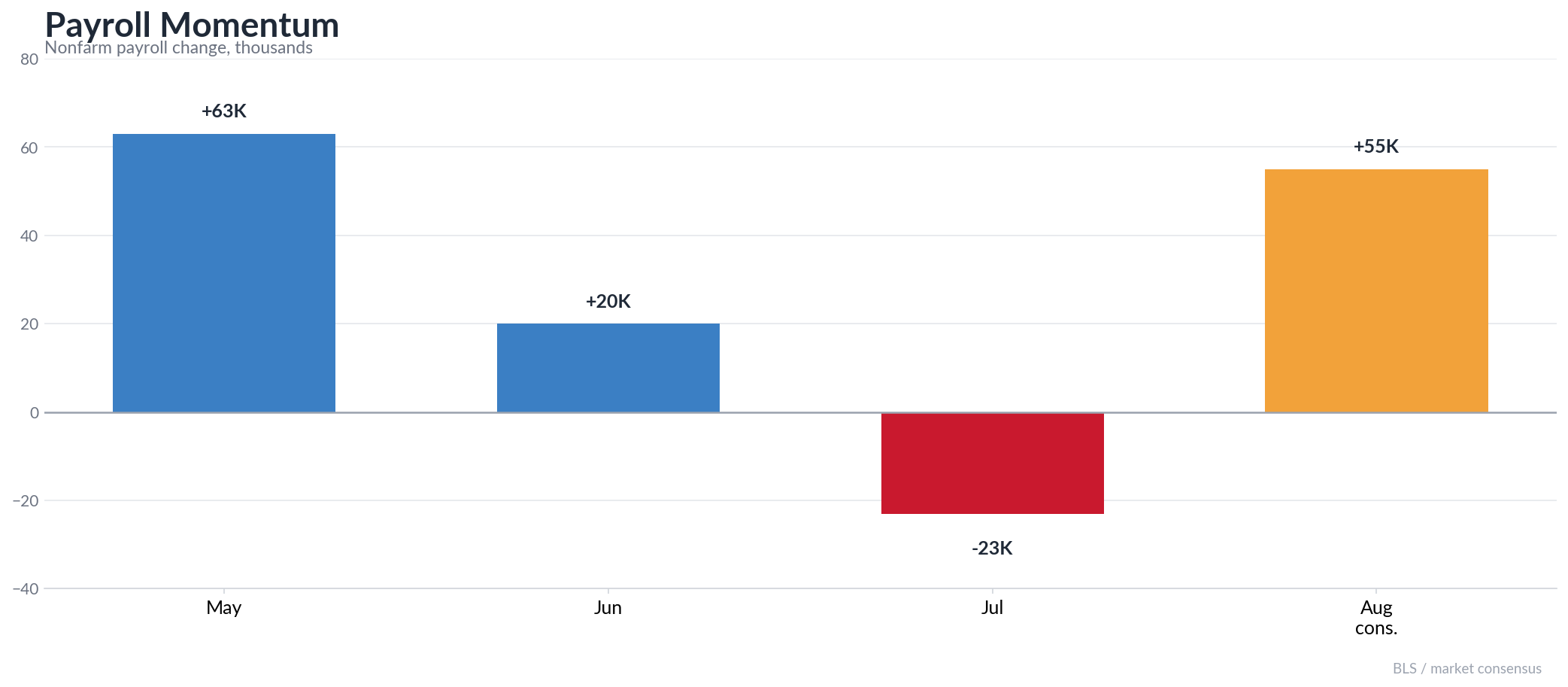
The U.S. Bureau of Labor Statistics (BLS) will release the August Non-Farm Payrolls (NFP) report on Friday, September 4, 2026, at 20:30 Beijing time. This data point stands as the most critical employment indicator ahead of the Fed's September FOMC meeting and will directly dictate market pricing for the future rate path.
In July, U.S. non-farm payrolls fell by 23,000, significantly missing market expectations. Furthermore, combined job additions for May and June were revised down by 103,000, dragging the three-month average payroll growth down to roughly 20,000. However, the unemployment rate remained low at 4.1%, and recent initial jobless claims have hovered steadily around 200,000, indicating that mass layoffs have yet to materialize. The current labor market is best described as "hiring has clearly slowed, but companies are still reluctant to lay off workers."
2. Core Employment Metrics Forecast: A Return to Positive Growth Expected
• Headline NFP:
Mainstream consensus expects an addition of roughly 50,000 to 60,000 jobs. While a clear improvement from July's negative print, it remains historically subdued.
• Unemployment Rate:
Expected to hold steady at around 4.1%, though some institutions suggest it could tick up to 4.2%. With the labor force participation rate continuously declining, a low unemployment rate does not necessarily signal robust labor demand.
• Average Hourly Earnings:
Projected to grow by approximately 0.3% month-over-month. If wage growth noticeably exceeds expectations, it could reignite market fears regarding sticky inflation.
3. Leading Indicators: The "Low Hiring, Low Layoffs" Paradigm Persists
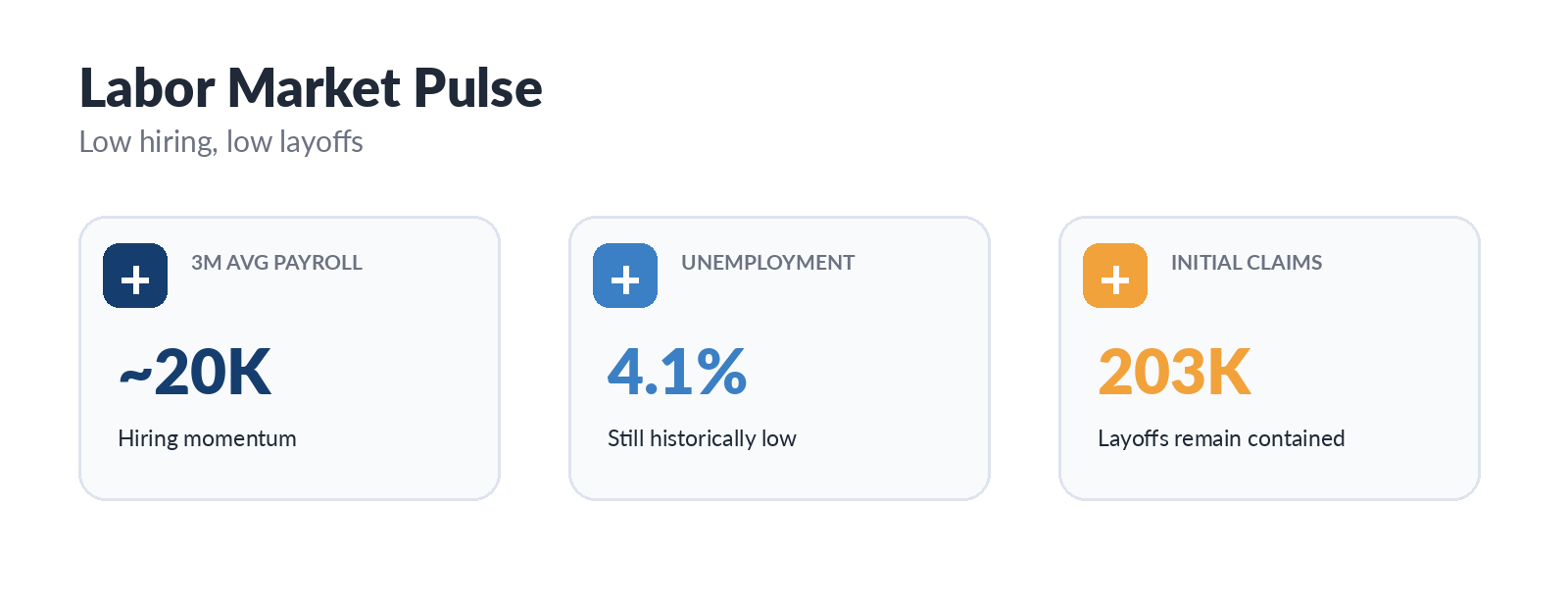
July's ADP private payrolls added a mere 44,000 jobs, illustrating that businesses have limited appetite for workforce expansion. Conversely, manufacturing employment indicators showed some improvement, providing a slight floor for the August NFP. Concurrently, through late August, initial jobless claims remained in the low 200k range, showing no signs of a rapid spike.
Therefore, the current labor market is not experiencing a classic "recessionary deterioration." Instead, companies are scaling back hiring and controlling headcount size without resorting to mass layoffs. Data points such as JOLTS, August ADP, and the ISM Services employment index will continue to shape market expectations leading up to the NFP release.
4. Three Key Focus Areas for This NFP Report
First, the Quality of the Rebound.
If job growth simply returns to the 50k–70k range, it only suggests that July's contraction has been patched; it does not prove the labor market is re-accelerating. The rebound will carry more weight if manufacturing, construction, and services sectors show synchronized improvement.
Second, Revisions to Prior Months.
NFP data has faced significant downward revisions multiple times in recent months. Even if the August print meets expectations, if June and July are revised sharply lower again, the market is likely to interpret the report as a whole as weak.
Third, Will Wage Growth Heat Up?
A scenario combining "mediocre job growth with strong wage growth" could keep the Fed hawkish. Conversely, if both employment and wages cool simultaneously, pressure for rate hikes will drop significantly.
5. Impact on the Fed and Financial Markets
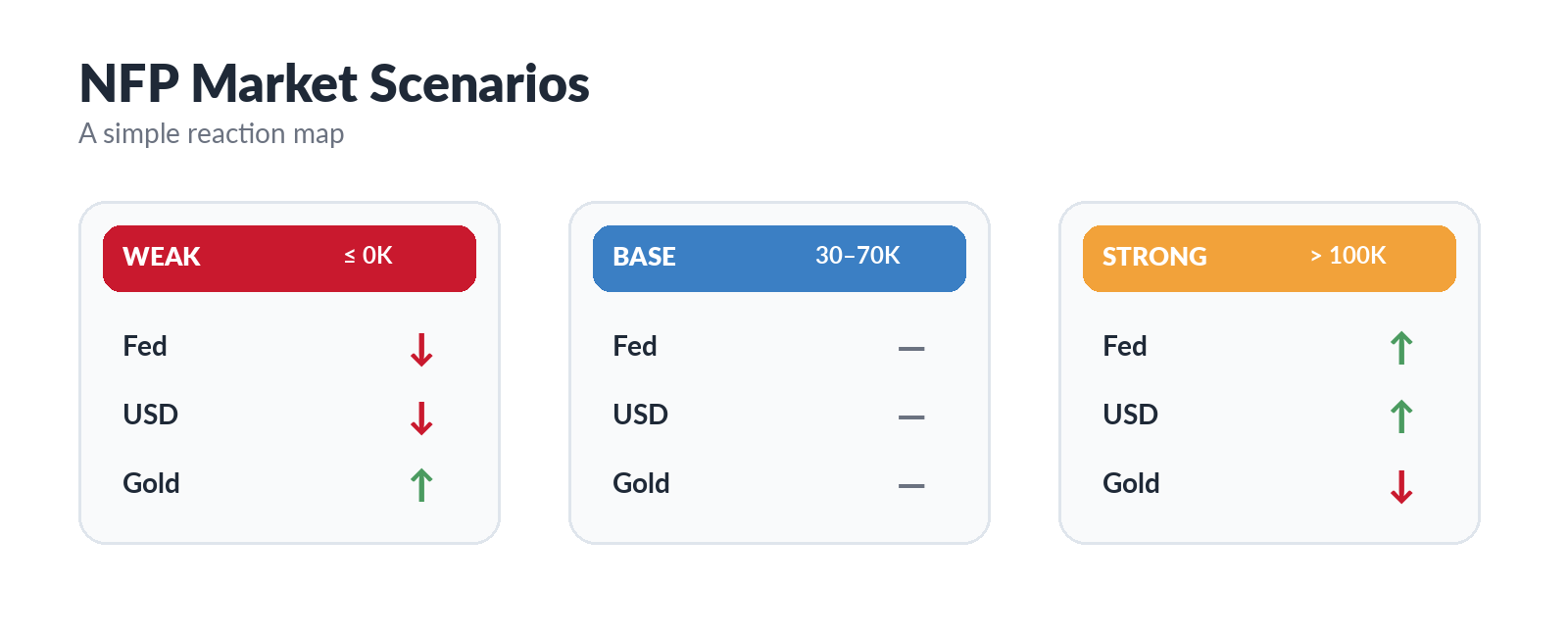
• If August job additions exceed 100,000
alongside elevated wage growth, markets may view July's weakness as a temporary anomaly and dial up Fed rate hike expectations. The U.S. dollar and Treasury yields would likely strengthen, applying downward pressure on gold.
• If job growth lands between 30,000 and 70,000
with a stable unemployment rate, it aligns with a "moderate cooling" baseline scenario. Market focus would likely pivot swiftly to upcoming inflation data.
• If job growth is near zero or negative again
accompanied by a rising unemployment rate or downward prior revisions, fears of severe labor market deterioration will intensify. Fed rate hike expectations would plummet, pressuring the dollar and yields, while providing a strong tailwind for gold.
6. Summary
Overall, there is a high probability that the August NFP will return to positive territory, but the expected addition of 50,000 to 60,000 jobs is hardly indicative of a re-accelerating U.S. labor market. The defining characteristic remains "low hiring, low layoffs."
Consequently, investors must look beyond the headline payroll number and closely scrutinize the unemployment rate, labor force participation, average hourly earnings, and prior month revisions. With the September FOMC meeting fast approaching, this Friday's data will serve as a pivotal near-term catalyst for gold, the U.S. dollar, and Treasury yields.