

Fed September Meeting Preview
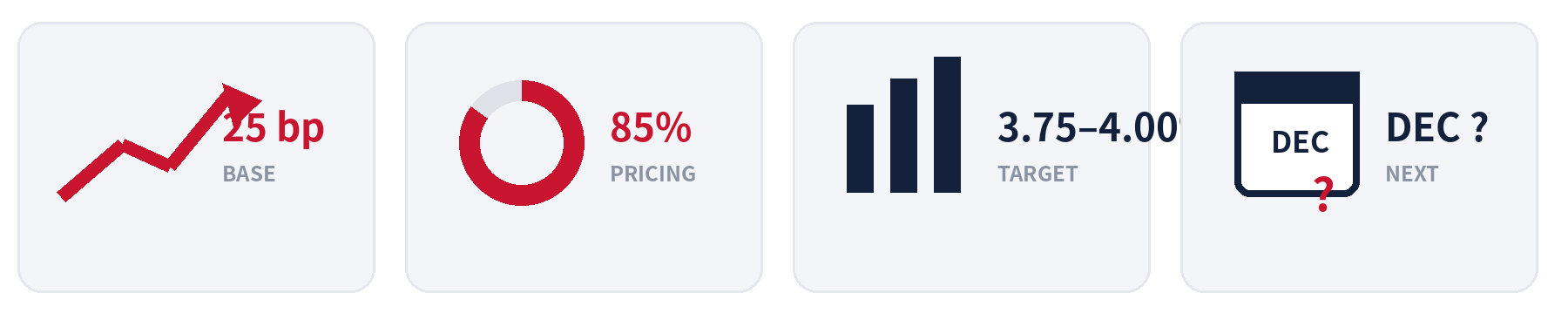
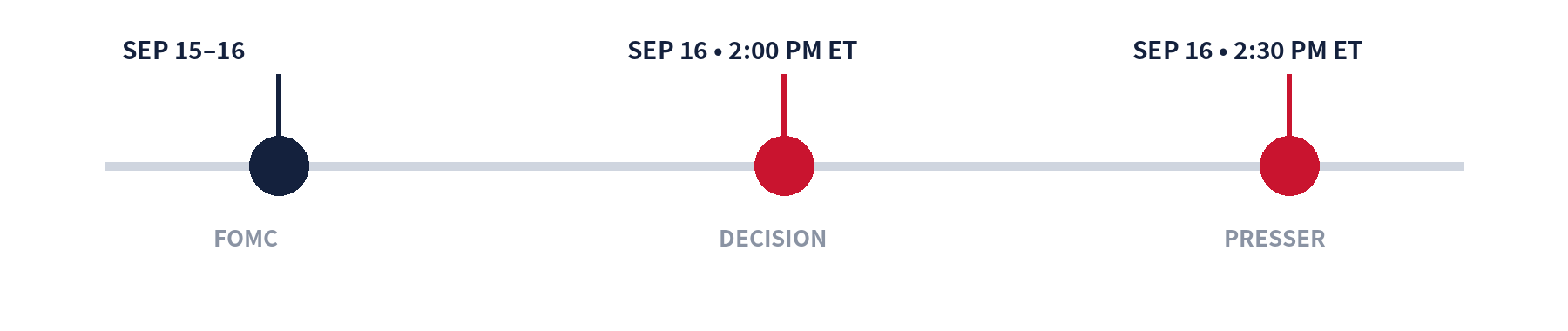
The Federal Open Market Committee (FOMC) convenes on September 15–16, with the rate decision scheduled for release on September 16 at 2:00 PM EDT (September 17 at 2:00 AM Beijing time), followed by the Chair's press conference at 2:30 PM. The Fed will also release updated Summary of Economic Projections. The current target range for the federal funds rate stands at 3.50%–3.75%.
Unlike the sharp division observed prior to the July meeting, recent CPI, PPI, employment, and crude oil figures have tipped the scale decisively toward the hawkish camp. The baseline expectation is a 25 bps rate hike; however, the market's primary sensitivity lies not in this 25 bps move itself, but in whether Chair Kevin Warsh signals the necessity of a second hike before year-end.
1. Rate Decision Preview: 85% Hike Probability, September Poised for Year's First Hike
On July 29, the FOMC held rates steady in a 9–3 vote, with three dissents favoring an immediate 25 bps increase. The policy statement emphasized that inflation remained above the 2% target, driven partly by supply-side energy shocks.
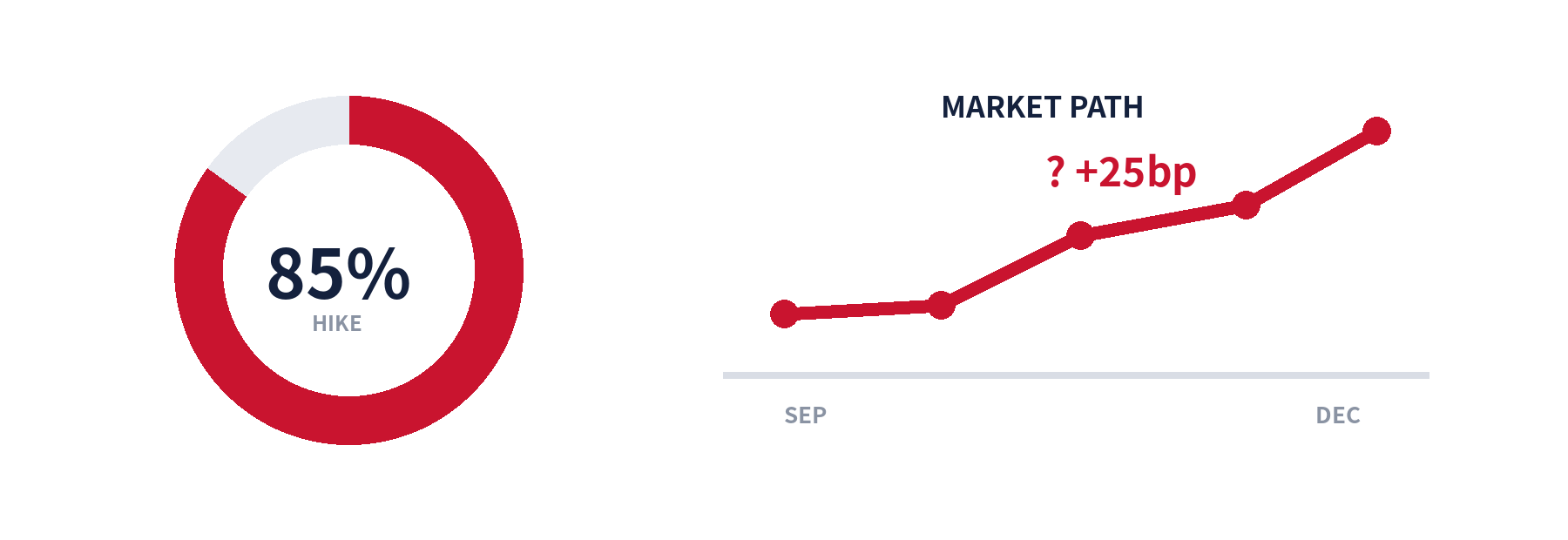
Short-term interest rate futures currently price in an approximate 85% probability of a 25 bps hike, up from roughly 70% prior to the CPI release. Pricing has also begun incorporating the likelihood of an additional move in December.
Warsh established a clear threshold during his August Jackson Hole address: the Fed can only be assured when underlying inflation is returning toward 2% "clearly and at a sufficiently rapid pace." Recent data fails to meet this condition, making a pause harder to justify. The meeting entails two distinct layers: first, whether to hike in September (largely consensus); second, whether further tightening follows, which will be dictated by the dot plot and press conference tone.
2. Resurgent Inflation: Core CPI, PPI, and Energy Generate Triple Pressures
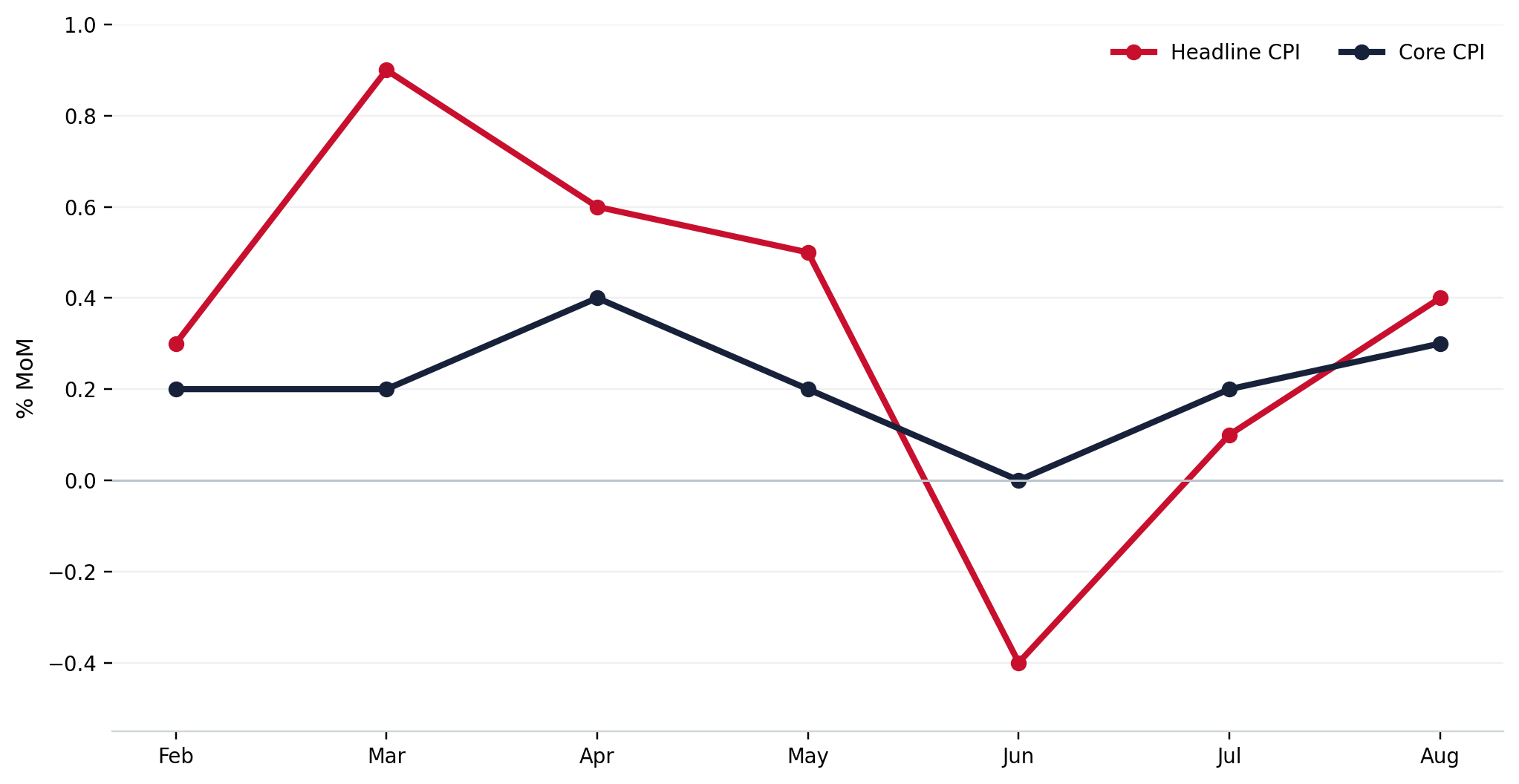
August CPI rose 0.4% MoM and 3.4% YoY. Core CPI increased 0.3% MoM (above the 0.2% consensus) and 2.4% YoY, with gasoline surging 3.9% MoM and the energy index advancing 2.1%.
Upstream price pressures were more pronounced: final demand PPI rose 0.4% MoM and 5.4% YoY, with goods prices jumping 1.1%, indicating that raw material and energy costs continue to pass through to production pipelines. Meanwhile, escalating Middle East conflict pushed crude back above $100 per barrel, heightening the risk of inflation persistence.
On the labor front, August non-farm payrolls added 162,000 jobs with the unemployment rate steady at 4.1%, accompanied by an upward revision of 55,000 across the prior two months. The labor market has not deteriorated sufficiently to warrant a pause.
3. Internal FOMC Divisions: Debate Pivots from "Whether to Hike" to "How Many"

With three dissents already recorded in July and two months of hot data reinforcing the hawkish thesis, internal policy deliberations have shifted:
• Hawks: Argue inflation risks outweigh labor market risks, advocating an immediate hike while keeping a December follow-up firmly on the table.
• Centrists: Support a hike but prioritize incoming data validation, resisting pre-commitments to sequential tightening.
• Doves: Contend that supply-driven commodity shocks should not be answered mechanistically with tighter policy, focusing instead on PCE components and policy transmission lags.
For Warsh, pausing after hot CPI, firm PPI, solid jobs, and climbing oil prices would trigger severe credibility scrutiny. The updated dot plot serves as the critical anchor: if the median end-2026 funds rate forecast remains near 3.8%–3.9%, it will be read as a "one-off calibration"; a shift toward 4.1% would confirm growing consensus for a subsequent year-end hike.
4. Heightened White House Pressure: Independence Under the Spotlight
Former President Donald Trump publicly reiterated ahead of the meeting that the US should enjoy the "lowest interest rates globally," linking trade policy to monetary easing. While the White House simultaneously pays lip service to Fed independence, the political friction remains acute just weeks ahead of midterm elections. A hike invites public criticism from Washington, while a pause risks accusations of yielding to political pressure.
The press conference will center on four key signals: ① Whether the hike is framed as a "calibration" rather than a new tightening cycle; ② Whether disinflation progress is described as "not fast enough"; ③ The assessment of persistence regarding energy and tariff shocks; ④ Explicit avoidance of pre-commitments for December.
Scenario Analysis and Summary
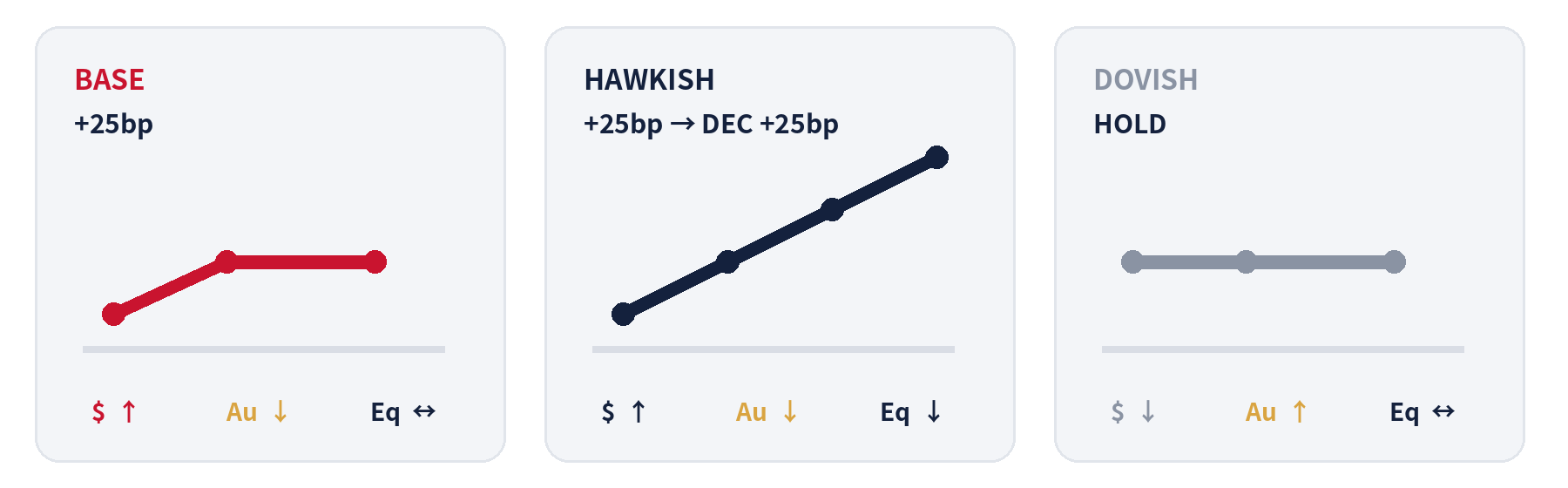
• Baseline Scenario (Highest Probability): 25 bps hike with optionality preserved for future tightening; US dollar and short-term yields firm, gold faces initial downside before reacting to policy nuance.
• Hawkish Scenario: 25 bps hike accompanied by a dot plot signaling a December follow-up; yields and dollar rally further, pressuring risk assets.
• Dovish Surprise: Rates held steady with emphasis on PCE and supply-side dynamics; bond yields fall, dollar softens, and gold rallies, but inflation credibility is challenged.
Baseline expectation: A 25 bps hike to a target range of 3.75%–4.00%. Even with a hike priced in, the dot plot distribution, vote split, and Warsh's communication will generate notable cross-asset volatility.