

On September 16, 2026, the Federal Open Market Committee (FOMC) concluded its two-day policy meeting, voting 12-0 to raise the target range for the federal funds rate by 25 basis points from 3.50%-3.75% to 3.75%-4.00%. The official statement noted that economic activity continues to expand at a solid pace, domestic spending demonstrates resilience, productivity growth remains robust alongside sound capital investment, and employment gains have largely kept pace with labor supply; however, inflation remains elevated, and this action aims to return inflation to the 2% objective in a more timely manner. This marks the first policy rate adjustment under Chair Kevin Warsh and formally translates several months of mounting hawkish posture into concrete policy action.
Note: The formal FOMC meeting minutes will be published on October 7; this document represents a real-time summary based on official post-meeting releases.
I. Unanimous Hike: Transitioning from Hawkish Dissent to Committee Consensus
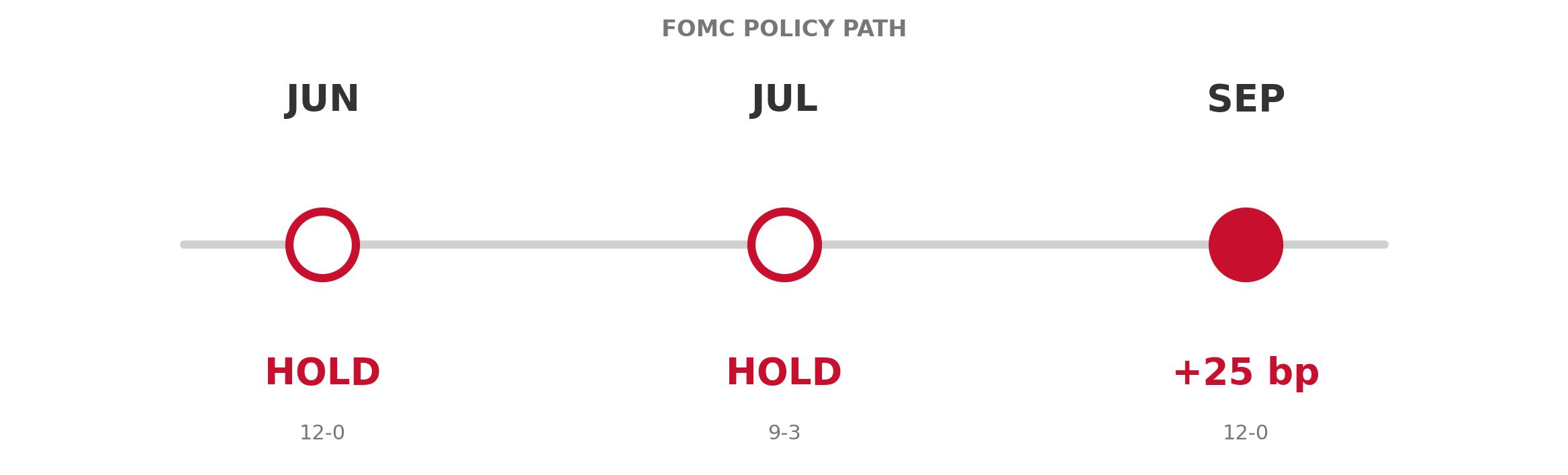
At the June meeting, the FOMC unanimously held the target range unchanged at 3.50%-3.75%; in July, although the pause was maintained, the vote shifted to 9-3, with Beth Hammack, Neel Kashkari, and Lorie Logan explicitly calling for an immediate 25 bps rate hike. By September, this view evolved into the unified stance of the entire Committee. In the press conference, Warsh explained that recent trends in payroll additions, private sector income, and business capital investment had all improved, while business credit flows remained solid. Crucially, he noted it was 'difficult to characterize broad financial conditions as restrictive,' a perspective widely endorsed across the FOMC. Therefore, this action serves as a recalibration of policy restraint: with the economy resilient and broad financial conditions remaining unrestrictive, the Fed opted to withdraw an additional degree of accommodation.
II. Labor Is Not the Primary Constraint; Policy Center Gravity Pivots to Inflation
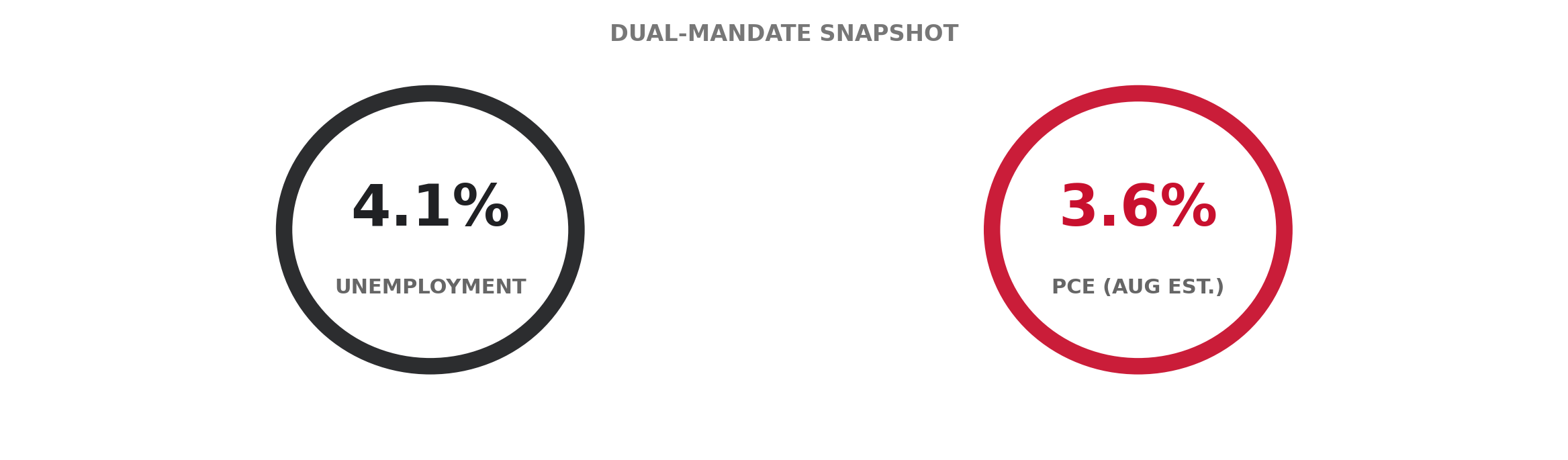
Stability across the labor market provided the essential foundation enabling the Fed to tighten policy with confidence. Warsh pointed out that the unemployment rate hovers near 4.1%, job openings and average weekly hours have increased, and initial jobless claims remain consistent with full employment, leaving the maximum employment mandate in overall 'good shape.' In contrast, inflation pressures stand out prominently. Warsh underscored that US inflation has run above target for more than five years, stating 'inflation is too high and has been too high for too long.' Based on recent CPI and PPI readings, August headline PCE inflation is estimated near 3.6% year-over-year with core PCE at roughly 3.2%; concurrently, annualized price increases across several key categories over 6-month and 12-month spans remain above 3%. His previously established benchmark was that further patience required clear evidence that underlying inflation was moving 'unambiguously and fast enough' toward 2%; the Committee determined in September that this threshold was not satisfied.
III. Four Major SEP Revisions: Higher Growth, Lower Unemployment, Higher Inflation, and Higher Terminal Rates
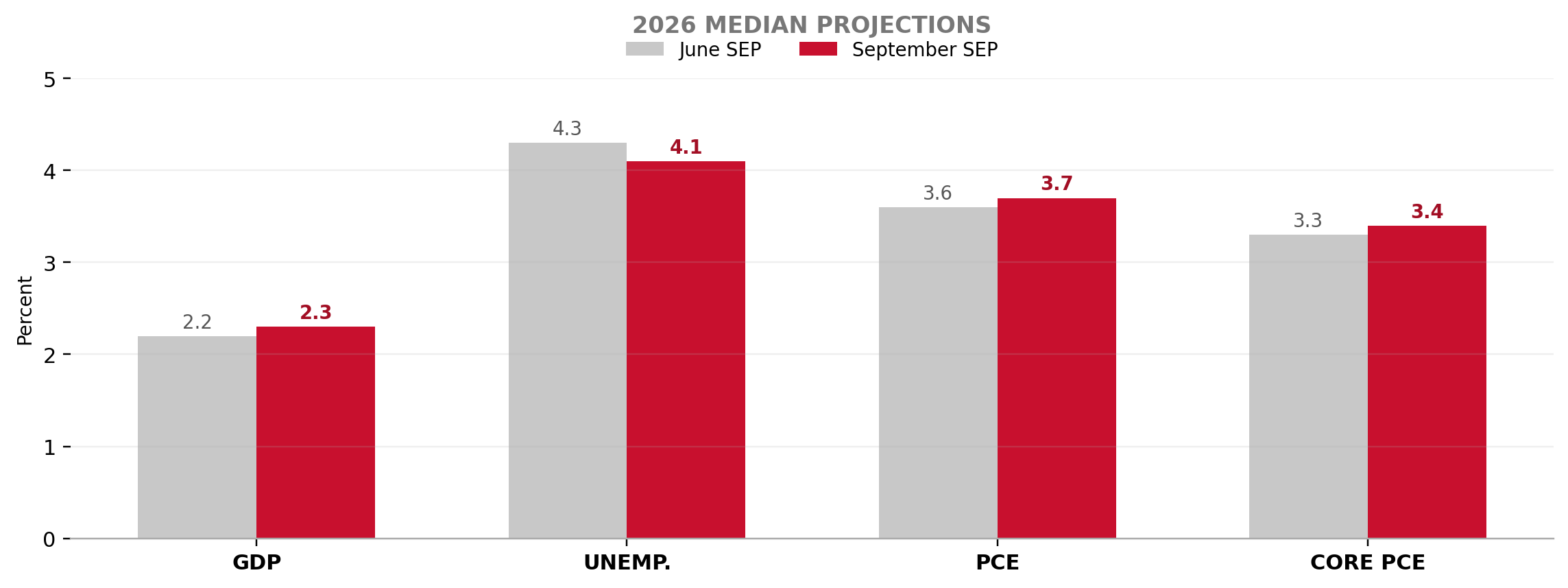
The Summary of Economic Projections (SEP) released alongside the statement provided further context for the decision. The median projection for 2026 real GDP growth was revised upward from 2.2% in June to 2.3%, and 2027 was raised from 2.3% to 2.4%; the 2026 unemployment rate forecast was revised downward from 4.3% to 4.1%, with 2027 similarly lowered to 4.1%. This reflects a more upbeat assessment of economic activity and employment than in June. Conversely, inflation projections deteriorated in tandem: 2026 PCE inflation was lifted from 3.6% to 3.7%, core PCE from 3.3% to 3.4%, while 2027 PCE inflation remained projected at 2.3%. Consequently, the SEP outlined an unambiguous combination: stronger-than-expected economic growth, sturdier employment, and more entrenched inflation. Under these conditions, the Fed judged that the economy can comfortably bear higher interest rates, allowing policy to lean decisively toward containing price pressures.
IV. A More Hawkish Dot Plot: Another 25 bps Hike in 2026 with Elevated Rates Extending into 2027
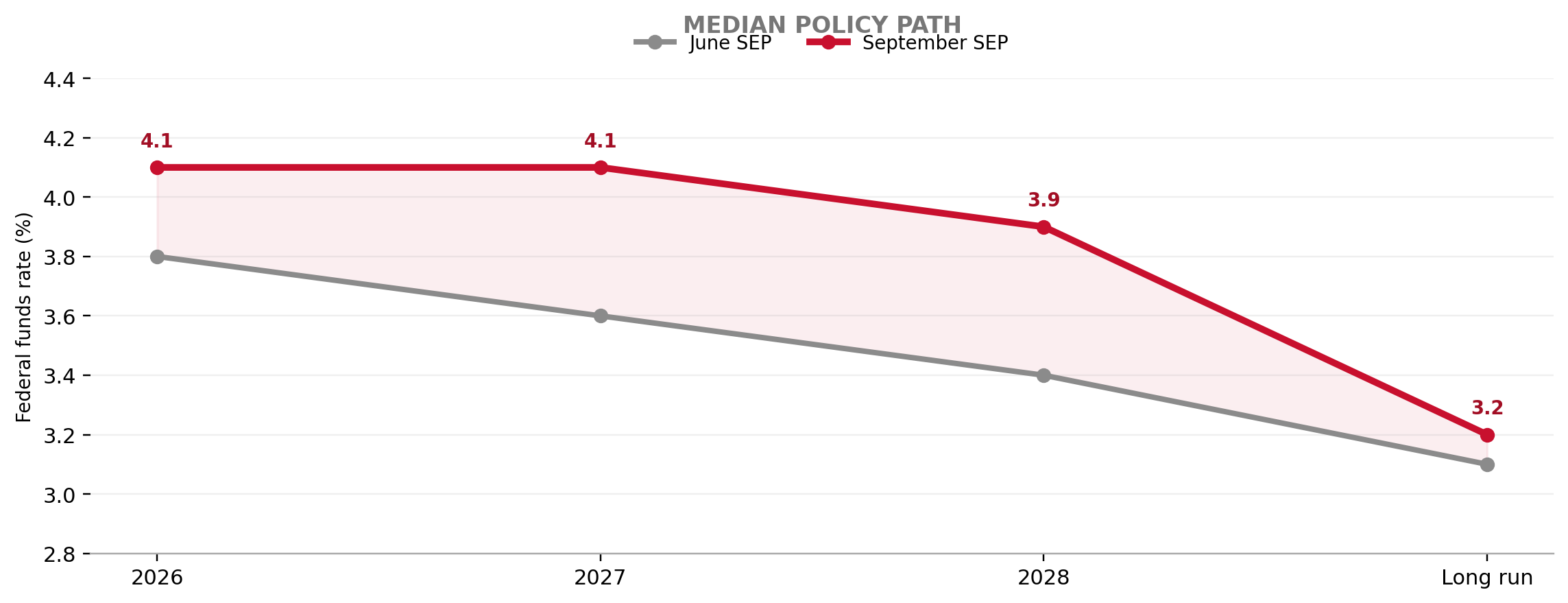
Compared with the 25 bps rate increase itself, the updated dot plot carries far greater market significance. The September SEP sharply revised the median federal funds rate projection for year-end 2026 upward from 3.8% in June to 4.1%, the 2027 projection from 3.6% to 4.1%, and 2028 from 3.4% to 3.9%. With the current target range midpoint situated at approximately 3.875%, the 4.1% year-end median implies another 25 bps rate hike before the close of 2026. More critically, the 2027 median rate forecast holds flat at 4.1%, underscoring that the baseline trajectory does not anticipate rapid pivot toward rate cuts, but rather 'another potential hike this year followed by an extended period with policy rates above 4%.' Market focus has decisively transitioned from July's question of 'will they hike again' to 'how many more hikes remain and how long will restrictive rates persist.'
V. Market Implications: The Primary Shock Stems from 'Higher for Longer'
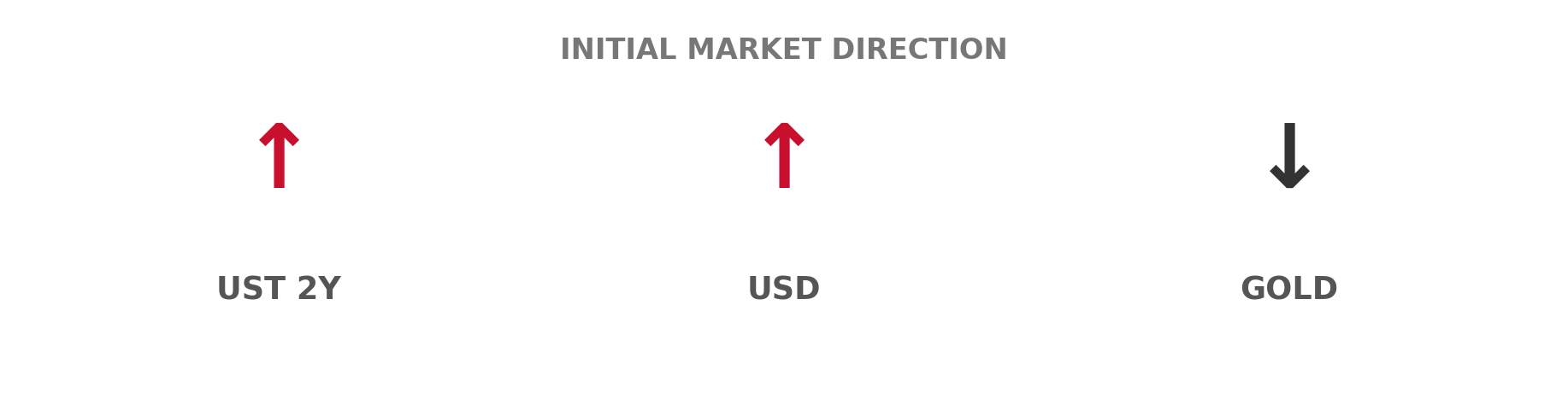
Because the 25 bps rate hike had been largely anticipated, post-meeting repricing was driven by the more hawkish SEP and Warsh's characterization of broad financial conditions. Short-end Treasury yields pushed higher, the US Dollar Index strengthened, and bullion faced downward pressure, reflecting recalibrated investor expectations for terminal policy rates. For non-yielding assets such as gold, the dominant headwind is not the single rate hike delivered in September, but the Fed's systematic upward revision to the future policy rate trajectory, signaling that rates above 4% may persist well into 2027. Going forward, inflation remains the paramount variable. Should core inflation metrics and commodity prices remain resilient, the threshold for a second rate hike this year will decline further; conversely, only a broad-based, persistent, and sufficiently rapid deceleration in underlying inflation would prompt the Fed to moderate its tightening pace.
Conclusion and Outlook
The September 2026 FOMC meeting marks the formal transition of Warsh-era monetary policy from a 'hawkish pause' to 'active tightening.' Moving from a unanimous hold in June, to three hawkish dissents in July, and finally to a 12-0 unanimous rate hike in September, Committee consensus regarding inflation risks has solidified. The true essence of this meeting extends beyond the 25 bps rate hike to the core logic articulated in the SEP: stronger growth, lower unemployment, and higher inflation warrant a higher policy rate. Under the latest dot plot, another 25 bps hike this year constitutes the median view, while policy rates holding at 4.1% through year-end 2027 reaffirm that 'higher for longer' has reclaimed center stage as the dominant policy framework. The core question for markets going forward is crystal clear: can inflation cool fast enough, and will forthcoming data prove sufficient to dissuade the Federal Reserve from delivering its next rate increase.
Sources: Federal Reserve FOMC Statement, Summary of Economic Projections, Chairman Warsh Press Conference, September 16, 2026; Federal Reserve H.15.