

US and Iran Erupt in Largest Mutual Attacks in Six Months (2026/09/10)
1. Fundamental Analysis
Middle East War Continues to Escalate:
Military clashes between the US and Iran, alongside shipping disruptions in the Strait of Hormuz, continue to impact global energy supplies, with Brent crude rising near $101. Market pricing has shifted decisively toward energy cost ramifications: the longer supply risks persist, the heavier the impact on transportation, gasoline, and corporate input costs, reinforcing worries over a resurgence in US inflation.
High Energy Costs Keep Treasury Yields Elevated:
War-induced spikes in energy prices, coupled with resilient labor data, have bolstered inflation and monetary tightening bets, pushing the 10-year US Treasury yield to around 4.85% intraday. Simultaneously, market pricing for a September rate hike remains near 60%. While initial reactions to the Treasury's expanded buyback program were cautious, subsequent robust demand for the $39 billion 10-year note auction—clearing at 4.834% with a 2.71 bid-to-cover ratio—helped temper further upward yield pressure.
Tonight's PPI and Tomorrow's CPI to Validate Cost Pressures:
The Bureau of Labor Statistics confirmed August PPI will be released tonight at 20:30 Beijing time, with August CPI due at the same time tomorrow. Given ongoing labor market resilience and elevated energy costs, traders are closely watching whether price pressures have transmitted further into producer and consumer baskets. Hotter inflation readings could harden tightening bets; conversely, softer prints could offer relief from current high rate pressures.
2. Technical Analysis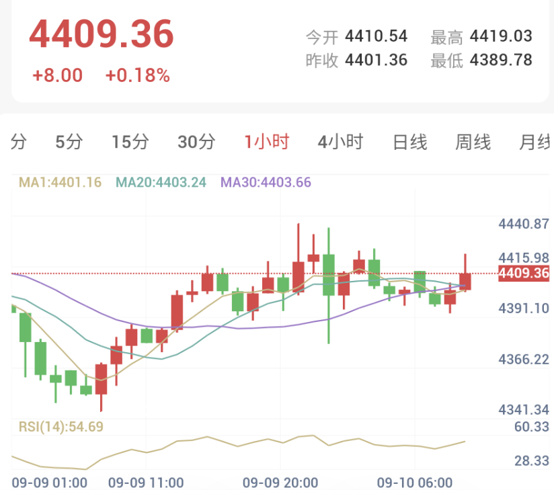
1-Hour Timeframe (Intraday Short-Term: Choppy Rebound)
• Trend Assessment: Spot gold trades near 4,409.36, with today's range between 4,389.78 and 4,419.03.
Prices have climbed back above the MA1, MA20, and MA30, signaling a corrective bounce from recent lows. However, moving averages remain tightly compressed rather than fanning out into a clear bullish expansion, indicating a choppy consolidation rather than an established trend reversal.
• Indicator Monitoring: RSI(14) registers at 54.69, positioned in neutral-to-bullish territory. Primary overhead resistance lies at 4,415–4,420, with secondary resistance around recent swing highs.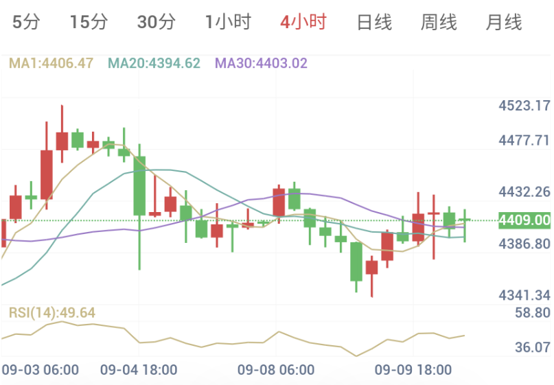
4-Hour Timeframe (Medium-Term Trend: Neutral-to-Weak / Rebound Capped)
• Trend Assessment: Prices sit marginally above the three primary 4-hour moving averages.
Although bullion has returned to the vicinity of short-term moving averages, broader 4-hour price action represents corrective consolidation following a sharp drop. Overhead resistance near 4,430 has not been decisively cleared, preventing confirmation of a sustained upward trend.
• Indicator Monitoring: RSI(14) prints at 49.64, hovering near the 50 centerline and confirming balanced 4-hour momentum.
3. Trading Execution Plan
While current technicals do not constitute an outright breakdown structure, elevated energy costs, persistent inflation expectations, and high Treasury yields warrant a single-condition plan to sell on rallies upon confirmed exhaustion.
• Strategy Direction: Sell on Rallies
• Trading Signal: Sell
• Confidence Index: 65 / 100
• Entry Observation Zone: 4,415.00 - 4,421.00
• Median Entry Level: 4,418.00
• Stop Loss Reference: 4,444.00
• Take Profit Target: 4,366.00
• Risk/Reward Ratio: Approx. 1 : 2.00
[Execution Details]
Gold currently trades near 4,409; chasing short positions at current levels is not advised. The preferred setup is waiting for a retracement back into the 4,415–4,421 band.
If price action into this zone forms a 1-hour or lower-timeframe long upper wick, bearish engulfing pattern, lower high, or a brief false breakout above 4,420 that swiftly retreats, traders may view it as confirmation of upward exhaustion and position for short opportunities.
Risk Disclaimer
Financial trading involves unpredictable risks, including but not limited to the loss of principal. This analysis is for reference only and does not constitute direct investment advice. Investors should make independent judgments and decisions based on their own risk tolerance.