

I. Fundamental Analysis
US-Iran negotiation expectations reverse again, Middle East energy transit risks remain unaddressed:
The previous evening, Trump stated that Iran 'desperately wants' to reach an agreement with the United States and that Washington was willing to maintain engagement, briefly spurring hopes of de-escalation; however, on September 15, Secretary of Iran's Supreme National Security Council Mohsen Rezaei explicitly responded that no talks with the US would take place until Iran's conditions were fully met.
Concurrently, Houthi forces continued expanding operational control over key positions across the Bab el-Mandeb Strait and the Red Sea coastline, demonstrating that regional tensions have not substantively eased despite Washington's diplomatic overtures. In other words, the energy risk premium shed the prior evening was priced straight back into the market overnight.
Saudi Arabia begins experiencing tangible physical supply disruptions:
In contrast to earlier concerns regarding potential disruptions, last night's critical development was that actual trade flows began to be impeded. Saudi Arabia has notified selected European buyers of cancellations for several September cargo loadings, while loadings at the Red Sea Yanbu terminal have been paused; additionally, market estimates indicate that the damaged East-West Pipeline may require 6 to 8 weeks to fully repair.
Riyadh currently contends with transit bottlenecks through the Strait of Hormuz, damage along its western alternative pipeline network, and heightened security risks near Bab el-Mandeb, compromising alternative bypass routes originally designed to mitigate Hormuz vulnerability.
Fed rate hike largely absorbed by markets, key focus shifts to forward tightening signals: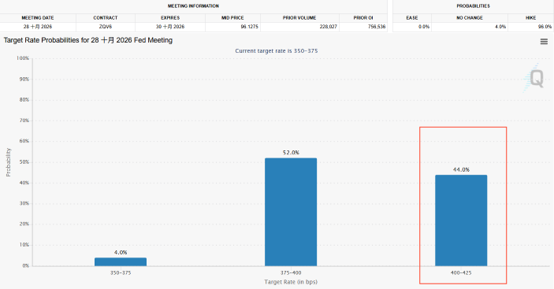
Persistently elevated energy costs have intensified market anxiety over sticky inflation. As of last night, interest rate futures priced in a 93%–94% probability of a 25 bps rate increase at tonight's FOMC meeting, with roughly a 44% implied probability of a follow-up 25 bps hike in October. Consequently, markets are moving beyond debating 'whether a hike occurs tonight' to pricing 'whether monetary policy will stay restrictive thereafter.'
Ahead of the central bank announcement, US retail sales data at 20:30 Beijing time will draw preliminary attention, followed by the FOMC rate decision at 02:00 on September 17 and Chair Powell's press conference at 02:30.
II. Multi-Timeframe Technical Analysis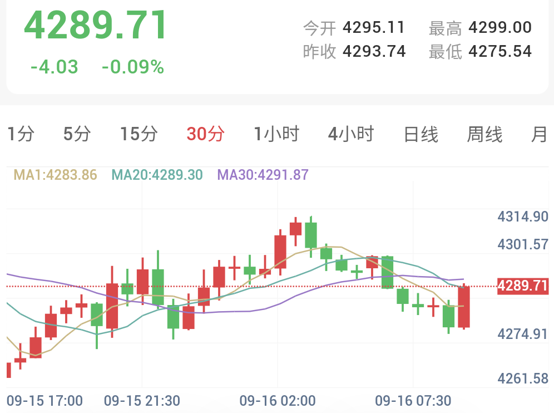
30-Minute Timeframe (Intraday Short-Term: Bearish Bias / Lower-Range Rebound)
Trend Assessment: The 30-minute timeframe currently trades near 4289.71, with an intraday range between 4299.00 and 4275.54.
Price currently fluctuates above MA1 but remains pinned close to MA20 and below MA30. After rebounding to around 4315 last night, bullish momentum stalled, producing a lower high indicative of low-range consolidation within a broader descending structure.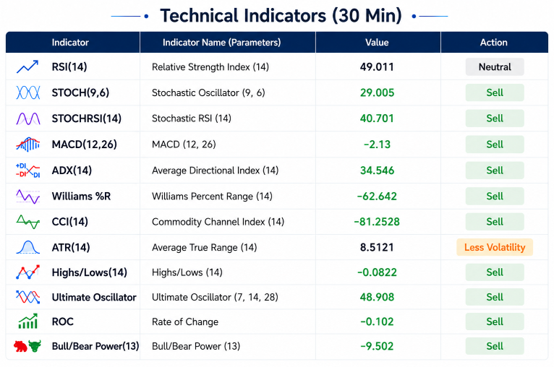
Indicator Monitoring: 30-minute technical gauges predominantly reflect a Strong Sell summary, comprising 10 sell signals and 1 neutral. RSI(14) stands at 49.01, MACD prints at -2.13, and ADX registers at 34.55, with Williams %R, CCI, ROC, and Bull/Bear Power all registering depressed readings.
While bears hold clear tactical control, price action is pressing near recent lows, making immediate short chasing unfavorable.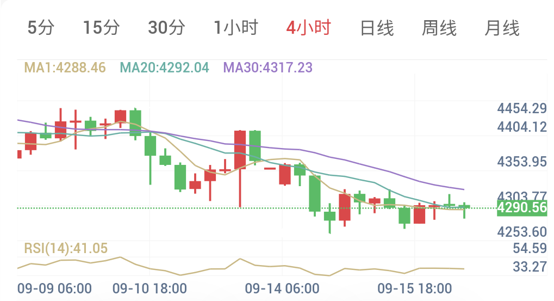
4-Hour Timeframe (Medium-Term Trend: Weak Consolidation Near 4300)
Structural Analysis: Higher-timeframe peaks and troughs continue their downward trajectory, with the 4-hour MA30 sloping decidedly downward. Horizontal drift around 4300 has not negated the broader descending channel. The 4315–4320 band constitutes a well-defined overhead resistance zone on rebounds.
Indicator Monitoring: RSI(14) registers at 41.05, remaining below the 50 centerline and confirming subdued medium-term momentum.
III. Trading Execution Framework
Integrating the 30-minute Strong Sell signals with the 4-hour descending trend—and accounting for potential pre-FOMC volatility—today's approach adopts a conditional sell-on-rebound plan.
Strategic Bias: Short on Rebound
Trading Signal: Sell (Condition-Triggered)
Confidence Score: 70 / 100
Entry Monitoring Zone: 4298.00 - 4305.00
Median Entry Level: 4301.50
Reference Stop-Loss: 4320.00
Target Take-Profit: 4265.00
Risk-to-Reward Ratio: Approx. 1 : 2.0
【Execution Notes】
With gold oscillating near 4290, direct selling at current lows is not recommended. A more prudent execution entails waiting for price to retrace upward into the 4298–4305 zone.
This area aligns with the 4300 psychological benchmark and coincides with 30-minute short-term technical resistance; should a rally extend toward 4315, it would confront prior 30-minute highs and the descending 4-hour MA30 at 4317.23, reinforcing barrier strength.
Tonight's core focal point: Given that markets have fully discounted a 25 bps hike, substantive repricing risk stems from the dot plot projections and Chair guidance regarding subsequent tightening pace, rather than the baseline rate outcome.
Risk Disclaimer
Financial markets carry inherent risks, including the potential loss of principal. This analysis is provided for informational purposes only and does not constitute direct investment advice. Investors must conduct independent evaluations and make decisions aligned with their personal risk tolerance.
Saudi Energy Supply in Crisis! Gold Under Heavy Downward Pressure (2026/09/16)
Published: 2026-09-16 09:49:15