

Market Fundamental Analysis
Over the weekend, Yemeni Houthi forces launched missile and drone strikes targeting sensitive infrastructure in the Saudi capital, Riyadh. However, easing energy prices and heightened global rate hike expectations offset geopolitical safe-haven bids, prompting gold to tick lower during the Asian session. Supported by cooling inflation expectations after benchmark energy prices declined for three consecutive sessions, spot gold recorded its first weekly gain in four weeks last Friday.
A synchronized tightening cycle among global central banks is taking shape. The Bank of Japan lifted its policy rate by 25 basis points to 1.25% last Friday—its highest borrowing cost since 1995—following the Federal Reserve's 25 bps rate hike to 3.75%-4.00% earlier in the week and an ECB rate increase the prior week. Energy-driven inflation has forced major central banks into parallel tightening paths, with markets pricing in further rate increases. While gold is traditionally viewed as an inflation hedge, ascending benchmark interest rates raise the opportunity cost of holding zero-yielding bullion, capping gold's upward expansion over the near term.
Société Générale and other institutional houses published constructive medium-to-long-term reports, anticipating that real yields will eventually turn lower later in the tightening cycle alongside US dollar softness and recovering investor demand. SocGen projected bullion will reach $4,750/oz in Q4 this year, rising toward $5,000 in Q2 2027 and $5,250 by Q3 2027. These forecasts align with Goldman Sachs' year-end target of $4,900 and JPMorgan's $4,500 projection, providing structural baseline support. Concurrently, consistent official sector gold accumulation and steady Chinese investment demand continue to uphold local premiums, whereas elevated retail prices keep physical demand subdued in India.
Gold Technical Analysis
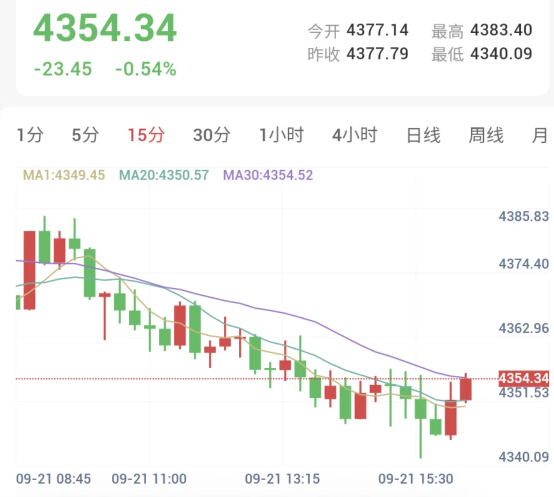
Daily Framework: Spot gold opened at $4,377.14/oz during today's Asian session and trended downward within a compact intraday range, printing a low of $4,340.09 and a high of $4,383.40 before trading near $4,354.34/oz (-0.54%). Moving averages on the daily chart maintain a golden cross configuration, preserving the broader bullish trend. Price remains wedged between the 20-day and 80-day moving averages, favoring patience until a confirmed daily break above the 20-MA appears before committing to long positions.
Intraday Short-Term (15-Minute): Moving averages display a bearish alignment, with price consolidating near the 15-minute 20-MA at $4,350.57. The morning breakdown below the 20-MA provided an entry reference for short positioning, with stop-losses anchored above the daily peak of $4,383.40. Targeting a 2:1 risk-to-reward ratio or trailing the 20-MA remain effective strategies to secure realized profits.
Silver Technical Analysis
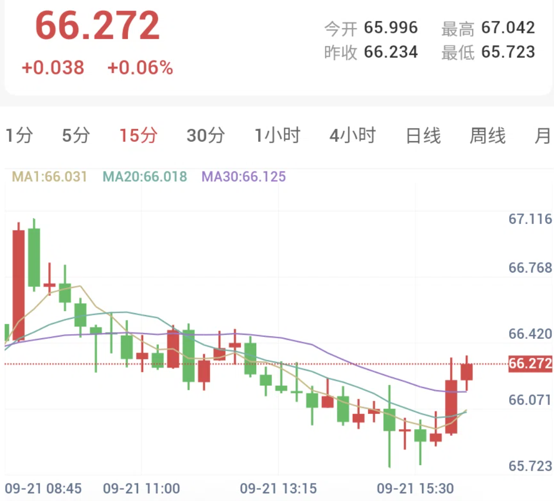
Daily Framework: Spot silver opened at $65.996/oz today, oscillating in a tight range to register a high of $67.042 against a low of $65.723, currently trading near $66.272/oz (+0.06%). Daily moving averages remain in a golden cross, supporting a constructive bias. Price has cleared the daily 20-MA, with the breakout around $66.246 offering an entry reference for medium-term longs, anchored by a stop-loss beneath the structural low of $62.300.
Intraday Short-Term (15-Minute): Moving averages are interwoven in sideways consolidation, with price tracking slightly above the 15-minute 20-MA ($66.018). With prices consolidating near the moving averages, traders can await a decisive break beneath the 20-MA at $66.018 to evaluate intraday short setups, utilizing a stop-loss above $67.042 and targeting a 2:1 risk-reward objective. Conversely, if prices hold securely above $66.018, remaining on the sidelines until directional momentum clarifies is advisable.
Risk Warning
Financial markets involve unpredictable risks, including but not limited to the loss of principal. This analysis is for reference only and does not constitute direct investment advice. Investors must make independent assessments and decisions aligned with their personal risk tolerance.