

I. Gold Plunges to Lowest Since August 5 Overnight, Stages Mild Rebound in Early Asian Trade
On September 28, spot gold fell 4% to settle at $4,114.93 per ounce, hitting an intraday low of $4,110.80, its lowest level since August 5; US gold futures fell 3.5% to settle at $4,168.40. Following the US rejection of the Iranian peace proposal, bulk energy prices rose, the dollar and Treasury yields climbed, and market expectations for further Federal Reserve rate hikes intensified. In early Asian trade on September 29, spot gold staged a mild recovery from its lows.
II. US Rejects Iran Proposal, Qatar Continues to Push Talks
US President Trump rejected a peace proposal put forward by Iran aimed at resolving bilateral conflict and reopening the Strait of Hormuz. Following the news, bulk energy prices surged by more than $4 per barrel intraday. The international benchmark energy contract ultimately rose $0.96, or 0.9%, to settle at $105.28 per barrel; the US benchmark energy contract rose $0.19, or 0.2%, to settle at $92.60 per barrel.
Qatari mediators subsequently stated they would hold separate talks with the US and Iran, causing bulk energy prices to give up a portion of their gains. The talks are expected to take place in New York, revolving around a revised version of the 7-day plan proposed by Iran during the UN General Assembly. Iran previously emphasized resolving the conflict through diplomacy, and Trump also stated that he expects US negotiators to hold more talks this week.
Preliminary Kpler data showed that as Saudi Arabia and the United Arab Emirates increased exports, Middle Eastern major energy producers' related exports recovered to 12.8 million barrels per day in September, the highest since the outbreak of war in February. UBS analyst Giovanni Staunovo noted that although vessel traffic through the Strait of Hormuz has increased, energy transportation volumes remain below pre-conflict levels, and supply remains insufficient.
III. Dollar Index Rises to 101.18, 10-Year Treasury Yield Touches Multi-Year High Intraday
On September 28, the US dollar rose 0.15% against major currencies, with the Dollar Index climbing to 101.18 and holding near a two-month high. The US 10-year Treasury yield rose 4.88 basis points to 5.23%, touching an intraday high of 5.2741%, the highest since mid-June 2007.
The 30-year Treasury yield rose 5.36 basis points to 5.5556%, reaching an intraday high of 5.5829%, the highest since mid-May 2004; the 2-year Treasury yield rose 4.99 basis points to 4.914%, touching 4.9555%, the highest since May 2024.
American Gold Exchange market analyst Jim Wyckoff stated that rising US Treasury yields, coupled with the dollar sitting at multi-week highs, jointly pushed precious metals prices down. LPL Financial Chief Fixed Income Strategist Lawrence Gillum believes uncertainties surrounding the Iranian conflict could still keep upward pressure on bond yields.
IV. 1-Hour London Gold Trades at $4,125.45, Price Still Below MA20 and MA30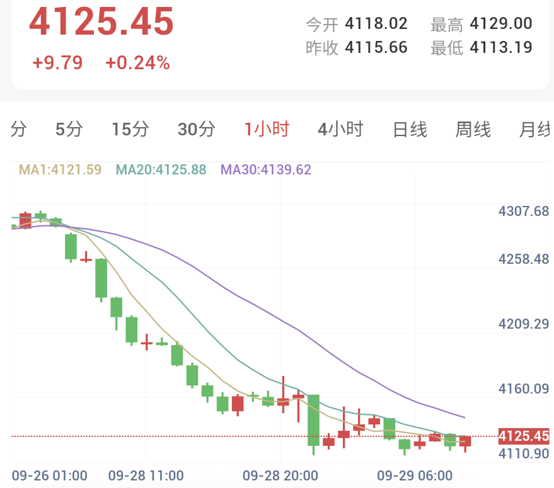
On the 1-hour timeframe, London gold traded at $4,125.45, up $9.79 or 0.24% intraday. Today's open was $4,118.02, prior close $4,115.66, with an intraday high of $4,129.00 and a low of $4,113.19.
MA1 stands at $4,21.59, MA20 at $4,125.88, and MA30 at $4,139.62. Current prices are above MA1, slightly below MA20, and still below MA30.
V. Fed December Rate Hike Probability at ~94%, Markets Focus on PCE and NFP This Week
The Federal Reserve raised its benchmark interest rate by 25 basis points earlier this month and signaled possible further rate hikes in coming months. Cleveland Fed President Hammack reiterated that inflation risks remain elevated. Fed Governor Cook stated on September 28 that artificial intelligence-related demand and rising bulk energy prices could keep inflation pressures ongoing in the coming months, though she did not explicitly advocate for further rate hikes.
CME Group's FedWatch Tool indicates traders see an approximately 94% probability of a 1-rate-hike by the Fed in December. In bond trading, expectations for a 25 basis point rate hike in October rose from 64% to around 70%, touching 73% intraday; markets have almost fully priced in four 25-basis-point rate hikes over the next 12 months.
Gillum believes inflation may moderate next year and some market pricing is overly aggressive. Following gold's sharp decline on September 28, markets this week will focus on job openings, the ADP employment report, the Personal Consumption Expenditures (PCE) price index, and the non-farm payrolls report, while keeping an eye on US-Iran talks progress and energy market shifts.
Middle East Deadlock Persists, US Treasuries at 20-Year Highs! Gold Stabilizes
Published: 2026-09-29 10:30:06