

I. Gold Faces Renewed Pressure During Asian Session Following Thursday Rebound
Spot gold rose 0.5% on Thursday to settle at $4,177.27 per ounce. In early Asian trading on October 2, 1-hour charts showed London gold trading at $4,147.95, down $29.50 or 0.71% intraday, indicating that the rebound momentum remains unstable.
II. Cooling US Inflation Lowers October Rate Hike Odds to 25%
US August inflation came in below expectations, with prior month price pressures also revised downward. Markets swiftly scaled back expectations for an October Fed rate hike, with probabilities tumbling from 69% a week ago to 25%. Recent public comments from Fed officials further reinforced these policy shifts.
New York Fed President John Williams stated there is no need to rush adjustments to the current monetary policy stance. Fed Vice Chair Philip Jefferson noted that any policy adjustments should be based on data trends, economic outlook changes, and risk balances, adding that markets are reassessing the economic outlook. Minneapolis Fed President Neel Kashkari remained open-minded regarding an October hike while acknowledging that current policy may not be particularly restrictive.
David Meger, Director of Metal Trading at High Ridge Futures, noted that cooling rate hike expectations provide support for precious metals. HSBC lowered its average gold price forecast for 2026 to $4,490 and for 2027 to $4,825, suggesting prices may remain under pressure in the near term but could be nearing a bottom. The bank also predicted that central banks might resume gold purchases if prices approach or drop below $4,000.
III. High Yields and Strong Dollar Continue to Cap Gold Rebound
The US 10-year Treasury yield previously touched 24-year highs and recorded its largest quarterly surge since 1994. Treasury prices rebounded and yields retreated on Thursday, with 2-year yields declining more noticeably, reflecting rapid cooling of short-term Fed rate hike expectations, though yields remain elevated overall.
Natixis portfolio strategists noted that yield trajectories have decoupled from certain fundamentals, creating conditions for a pullback. High yields and a strong dollar remain primary headwinds for gold, with the dollar index rising for six consecutive quarters, the euro falling to its lowest since May 2025, and French fiscal concerns alongside European bond sell-offs boosting the dollar's appeal.
IV. Energy Markets and Middle East Tensions Add Inflationary Variables
International benchmark energy contracts closed up over 4% on Thursday, surpassing $100 per barrel. News of major Asian energy processors suspending energy product exports, reports of the US potentially deploying a third aircraft carrier and up to 10,000 troops to the Middle East, and President Trump's hawkish stance on Iran jointly fueled energy markets and geopolitical risks.
The US also imposed a new round of sanctions targeting Iran's railway and automotive sectors. Meger warned that sustained sharp increases in energy prices or escalating Middle East conflicts could reignite rate hike expectations and hit market sentiment. Safe-haven demand provides baseline support for gold, but a strong dollar, elevated yields, and inflation concerns continue to drive volatility.
V. 1-Hour Chart Breaks Below Moving Averages; NFP Report Will Dictate Short-Term Direction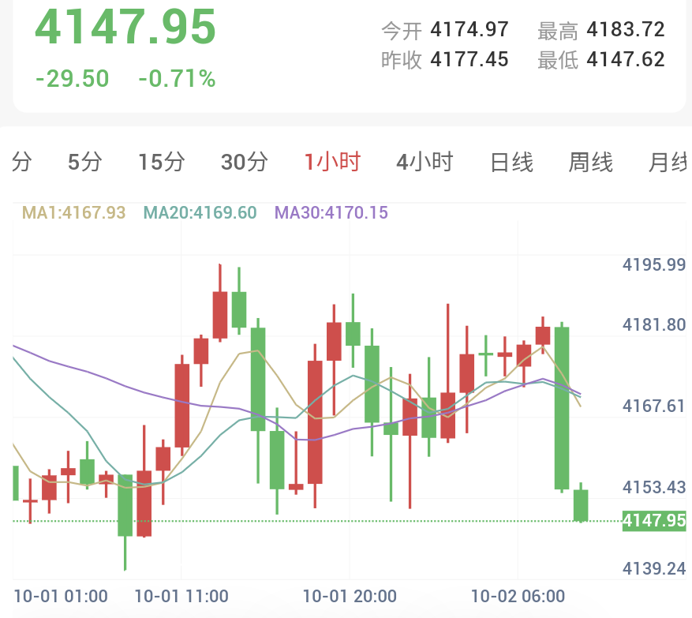
On the 1-hour timeframe, London gold traded at $4,147.95, down 0.71% intraday, sitting beneath MA1 ($4,167.93), MA20 ($4,169.60), and MA30 ($4,170.15); RSI, MACD, DIF, and DEA data were not displayed. Current charts indicate prices have fallen back beneath moving averages, requiring fresh fundamental catalysts for a short-term rebound.
Investors are awaiting the US September non-farm payrolls report. Recent data showing declining initial jobless claims and fewer layoffs indicate labor market resilience. A strong NFP report could reinforce expectations of economic resilience and sticky inflation, whereas a notable slowdown in hiring might cement expectations for a December rate hike rather than October. Employment data, energy shifts, Middle East developments, and Treasury yield movements will collectively test gold's ability to stabilize.
US August Inflation Cools! October Rate Hike Odds Plunge 50%
Published: 2026-10-02 10:20:03