

I. NFP Summary: Significant Cooling in Employment, 'Low Hiring, Low Layoffs' Trend Persists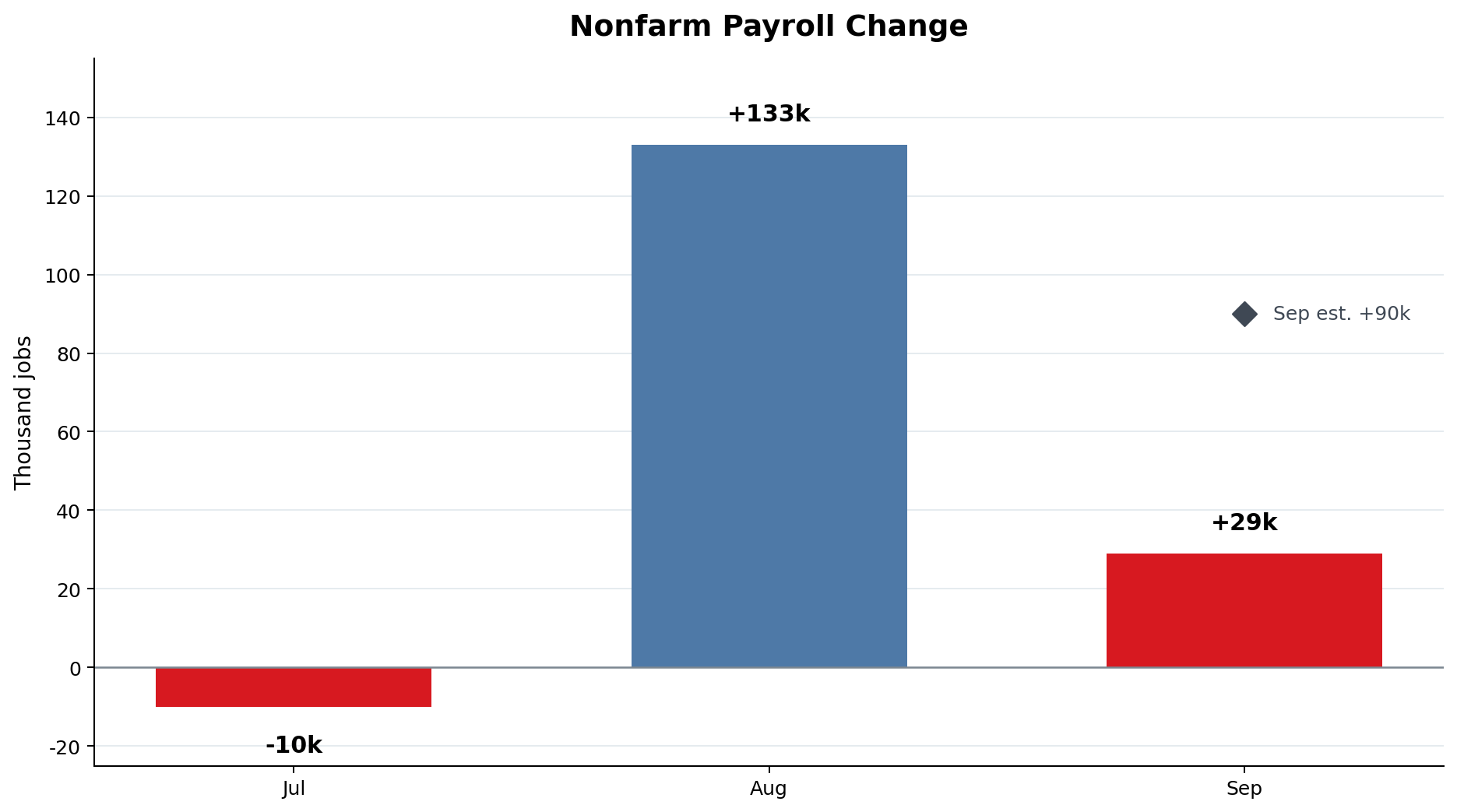
The September employment report released by the US Bureau of Labor Statistics on October 2 was significantly weaker than expected. Non-farm payroll growth was only 29k, less than a third of the market expectation of 90k; July was revised down from an increase of 21k to a decrease of 10k, and August was revised down from an increase of 162k to 133k, resulting in a cumulative downward revision of 60k over two months. After these revisions, average monthly job additions from July to September stood at roughly 51k, clearly slowing the pace of employment expansion.
The unemployment rate edged up from 4.1% to 4.2%, but the structural shift was not purely a deterioration. Household surveys showed a 406k increase in employment and a 485k increase in the labor force, pushing the labor force participation rate up from 61.6% to 61.8%. This means the rise in the unemployment rate stemmed more from workers re-entering the labor market rather than massive job losses. Initial jobless claims remained low with no widespread layoffs observed, leaving the labor market more akin to a 'low hiring, low layoffs' equilibrium.
Wage pressures softened further. Private non-farm average hourly earnings rose by just 0.1% month-on-month in September, while year-on-year growth slowed from 3.1% to 3.0%; average weekly hours held steady at 34.4 hours. Continued deceleration in wage growth indicates the labor market is not being driven by new inflationary pressures.
II. Sector Breakdown: Healthcare Continues to Provide a Floor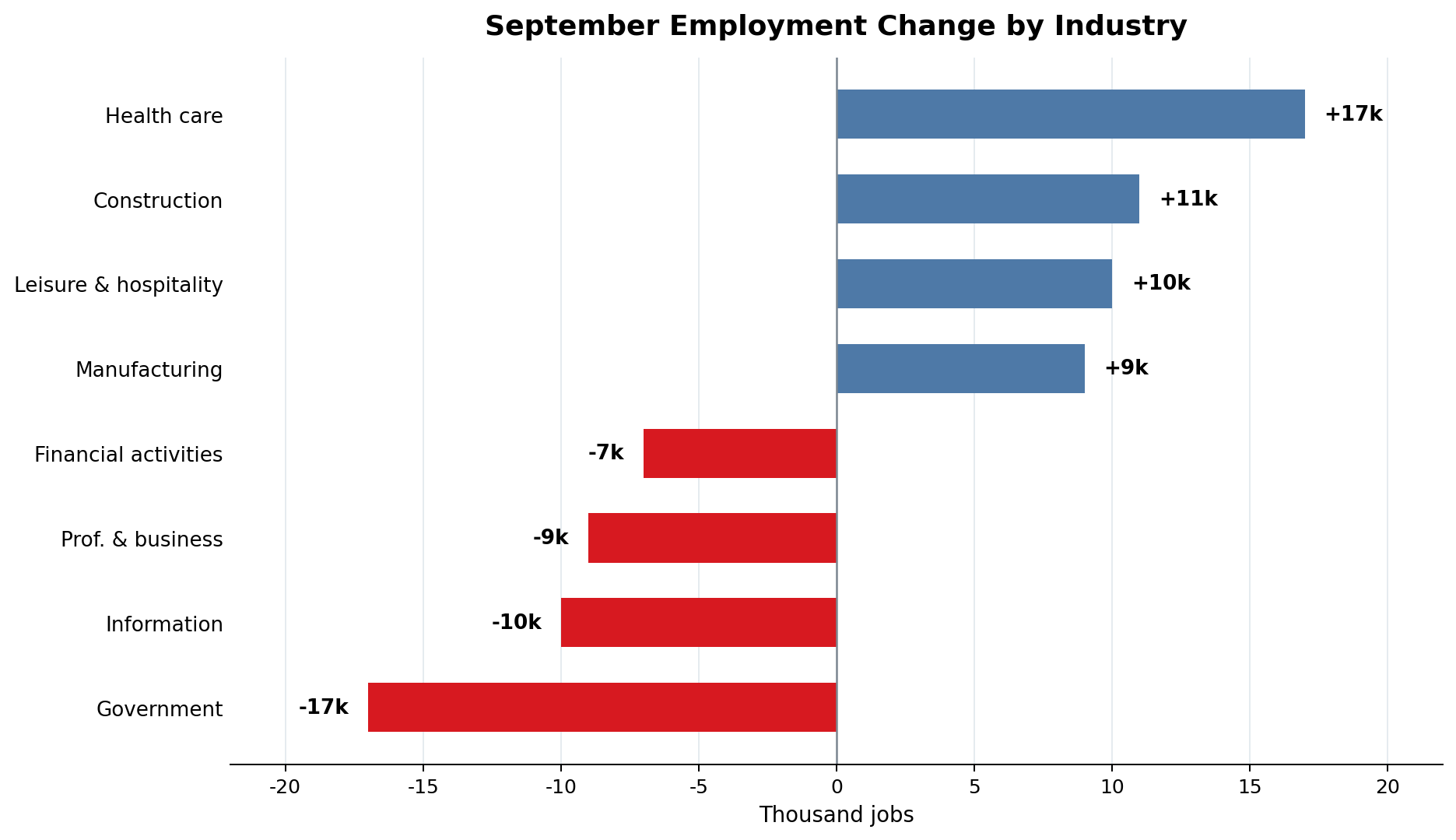
At the sectoral level, unified growth momentum was lacking. Healthcare added 17k jobs, remaining the primary support, though well below the 33k average monthly gain over the past 12 months; construction added 11k, manufacturing added 9k, and leisure and hospitality added roughly 10k. Overall, job gains remained concentrated.
White-collar and government-related sectors continued to face pressure. Information services lost about 10k jobs, financial activities dropped 7k, professional and business services fell 9k (with temporary help services accounting for a loss of about 10.9k), and government employment decreased by about 17k. Hiring appetite in select service and office roles remained subdued.
More importantly, the breadth of employment growth narrowed noticeably. The private sector employment diffusion index dropped from 57.6 in August to 49.0, hitting an 11-month low, implying that the number of industries shedding jobs slightly exceeded those adding jobs. The primary underlying concern currently is the shrinking pool of industries willing to expand headcount.
III. Federal Reserve: Decreased Necessity for Consecutive October Hikes, Room for Action Retained in December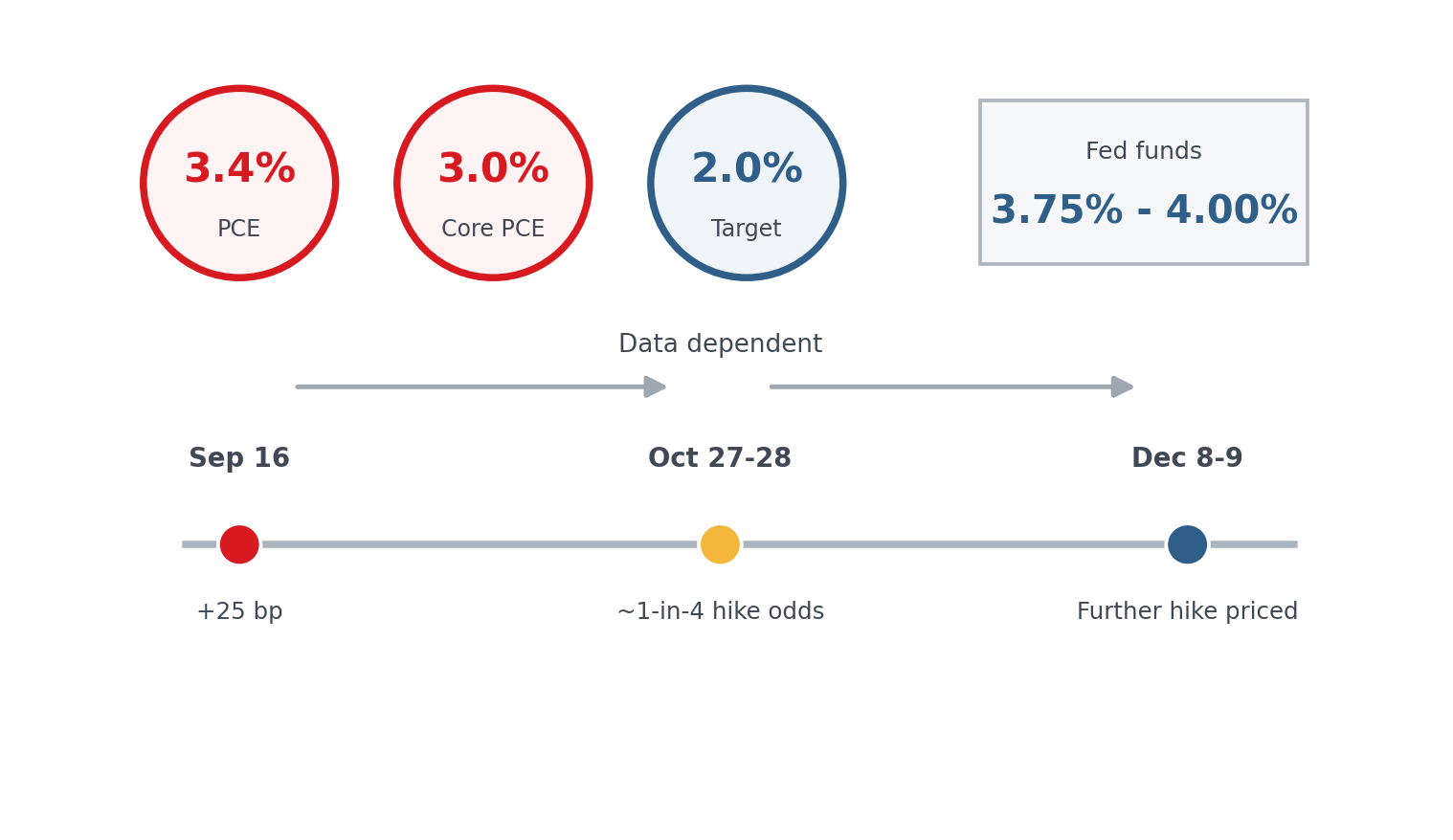
The Federal Reserve already raised the federal funds target rate by 25 basis points to 3.75%-4.00% on September 16, but the weak September NFP significantly reduced the urgency for another rate hike in October. Following the jobs release, market pricing for another hike at the October 27-28 meeting dropped to roughly 20% to 25%; meanwhile, traders generally still see a higher probability of further tightening in December.
The policy dilemma continues to stem from inflation. The US August PCE price index rose 3.4% year-on-year, and core PCE rose 3.0% year-on-year, both clearly exceeding the Fed's 2% long-term target.
New York Fed President John Williams stated on September 29 that policy action was already taken in September with no need to rush further adjustments; if the economy evolves in line with his forecasts, another rate adjustment later in the year remains possible.
Vice Chair Philip Jefferson similarly emphasized that rate adjustments must weigh broader data trends to gauge economic momentum and risks.
Consequently, this employment report essentially 'buys time' for the Fed. The September CPI release on October 14 and PPI on October 15 are far more likely than this NFP report to alter judgments for the October meeting. If inflation continues to exhibit stickiness, room for a December hike remains intact; if price pressures ease further, cooling employment and wages will strengthen the justification for pausing tightening.
IV. Conclusion and Outlook: Not an Employment Crisis, But Hiring Momentum Nearing Stagnation
Published in October 2026, the core takeaway of this September employment report is not a single 29k print, but rather multiple indicators collectively pointing to a cooling in hiring: July revised down to negative growth, August sharply revised lower, the three-month average payroll addition dropping to roughly 51k, year-on-year wage growth slowing to 3.0%, and the private diffusion index falling below 50. August's robust rebound failed to forge a sustained trend.
Concurrently, the 4.2% unemployment rate remains low, household surveys showed a 406k employment increase with the labor participation rate rising to 61.8%, and jobless claims show no signs of widespread layoffs, meaning current conditions fall short of an employment crisis. A more accurate characterization is 'low hiring, low layoffs, low wage growth': corporations are not widely slashing existing headcount, but new job creations are dwindling.
For markets, the core focus of the October FOMC reverts back to inflation. If CPI and PPI print strong, policy grounds for another rate hike within the year remain; if price pressures clearly moderate, weak hiring and wage cooling will enhance the value of waiting. Key milestones to watch next include the October 14 CPI, October 15 PPI, the October 27-28 FOMC meeting, and the October employment report scheduled for November 6.
Data Sources: U.S. Bureau of Labor Statistics, Federal Reserve, U.S. Bureau of Economic Analysis, Reuters.
September 2026 Non-Farm Payrolls Report
Published: 2026-10-05 10:24:50