

I. Introduction: Steady Stock Gains Meet Lurking Inflation Anxieties
The US Bureau of Labor Statistics (BLS) will release the May non-farm payrolls report on Friday, June 5, 2026, at 8:30 PM Beijing Time.
Right now, US stocks are on a tear, driven by AI tech stocks. The S&P 500 index has notched gains for nine consecutive weeks, pushing its year-to-date return past 10%. On the flip side, however, inflationary pressures in the real economy are quietly crawling back up.
Squeezed by geopolitical conflict—with three months of clashes disrupting energy supplies—the April Personal Consumption Expenditures (PCE) price index jumped 3.8% year-over-year, marking its biggest surge since May 2023.
With inflation staying uncomfortably high, the Federal Reserve's core focus has shifted away from "when to cut rates" to "do we need to hike again?" Consequently, this May payrolls report will serve as a crucial yardstick for the market to judge whether the economy is running too hot and where the Fed's rate path goes next.
II. Job Growth Expected to Slow Further
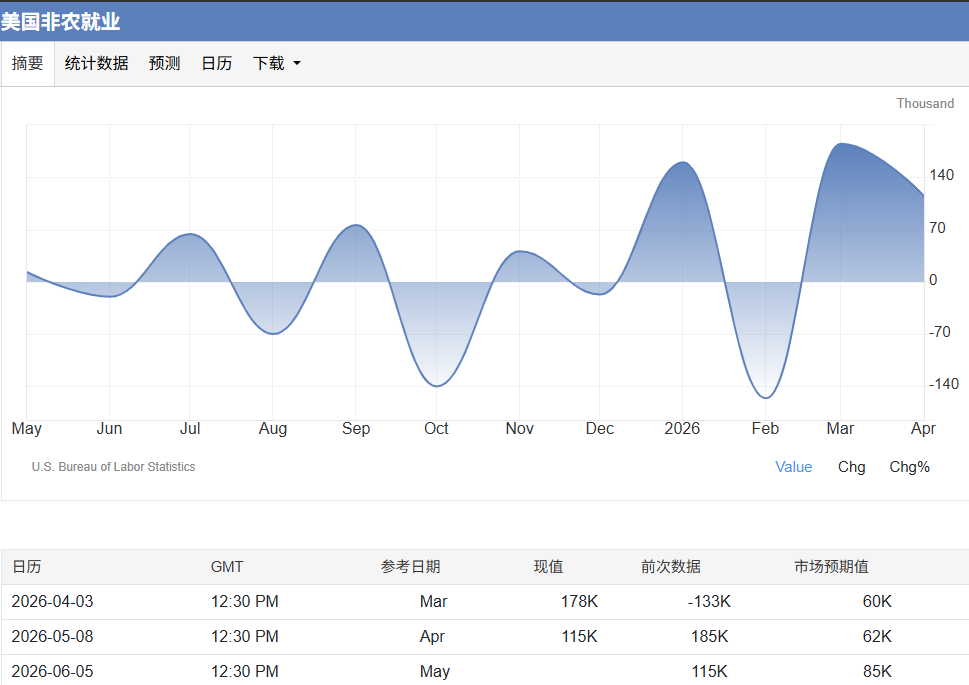
Interpretation: Current market forecasts suggest that the labor market will continue its trend of cooling down smoothly:
- Non-Farm Payrolls: The consensus expectation sits at +85,000 jobs, with the broader forecast range clustering between 85,000 and 96,000. This marks a step down from the 115,000 jobs added in April.
- Unemployment Rate: Projected to hold steady at around 4.3% (with some institutions predicting a tight window between 4.2% and 4.3%), virtually unchanged from last month.
- Wage Growth (Month-over-Month Average Hourly Earnings): Expected to tick up by 0.3%, slightly faster than April's 0.2% print. A re-acceleration in wages could inject fresh inflationary pressures into the service sector.
Leading Indicators:
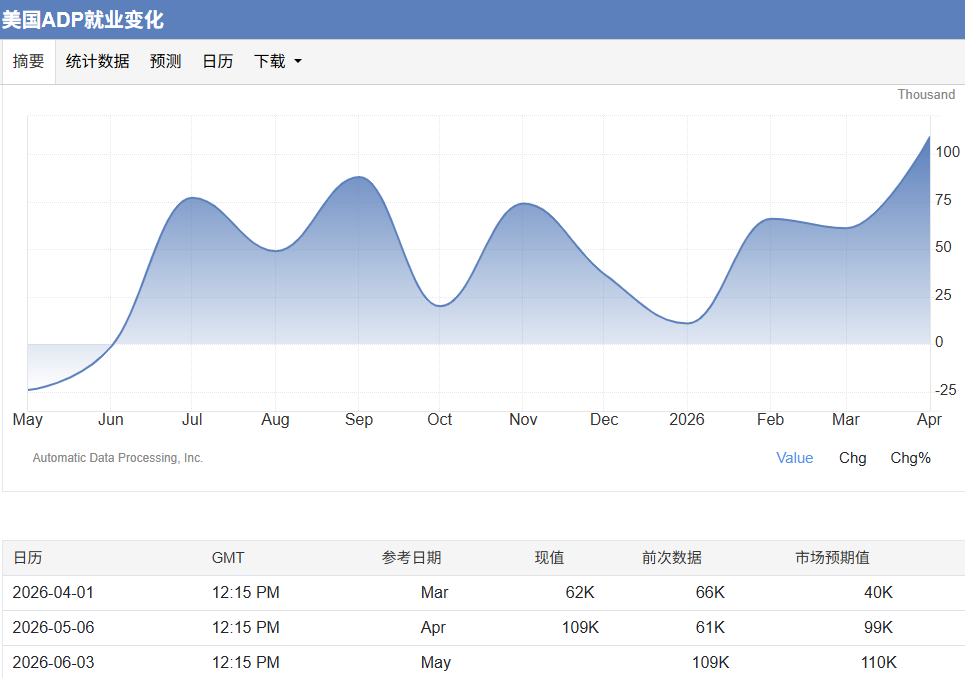
- ADP Private Payrolls (Released June 3): Market consensus points to an increase of 110,000 jobs for May, matching up closely with April's 109,000 reading. With the ADP forecast showing little variation, the odds of a massive outlier in Friday's official NFP report remain low.
III. What Is the Market Worried About?
Against a backdrop of persistent inflation and elevated Treasury yields—with the 10-year US Treasury yield hovering around 4.45%—the market's mindset heading into the NFP release can be broken down into three distinct scenarios:
- Scenario 1: A Moderate Slowdown (Job growth between 50,000 and 100,000) — The Ideal Soft-Landing Signal
- If the data lands close to expectations, it will confirm that the jobs market is cooling in an orderly fashion—neither flashing recession warnings nor pointing to an overheating economy. Under this goldilocks scenario, pressure on the Fed to hike rates further would ease, helping to stabilize Treasury yields. This would be a net positive for gold and US equities, especially mega-cap tech stocks.
- Scenario 2: An Unexpected Hot Print (Job growth clearing 150,000 with hot wage growth) — Triggering Rate Hike Panics
- If the data significantly overshoots expectations, fears that an overheating economy will keep fueling inflation will grip the market. This would spark a sharp spike in both the 10-year US Treasury yield and the US dollar. Given that the interest rate futures market is currently pricing higher odds for a rate hike this year than a rate cut, a strong payrolls print could lock in this hawkish outlook, dealing a heavy blow to gold and richly valued tech stocks.
- Scenario 3: Distinct Softness (Job growth below 50,000 or dipping into negative territory) — Igniting Recession Fears
- If the numbers come in exceptionally weak, market sentiment will quickly flip to anxiety over a US economic recession. While this would boost rate-cut expectations, sink Treasury yields, and provide a short-term lift to gold, stock markets could experience violent volatility over fears of shrinking corporate earnings.
IV. A New Era for the Fed and a Core Fundamental Test
It is worth noting that this payrolls report, alongside the inflation data arriving the following week, will represent the final batch of critical economic indicators before the newly appointed Fed Chair, Kevin Warsh, hosts his first FOMC policy meeting on June 16–17. Due to sticky inflation, the market has not only pushed out rate-cut expectations but has actively started guarding against the risk of rate hikes.
Additionally, the true strength of the tech rally will face a major test. On June 3, chip giant Broadcom will report its earnings. Given that the semiconductor sector has surged roughly 80% since late March, Broadcom's results will directly test the valuation sanity behind the current AI investment frenzy.
V. Conclusion and Other Key Observations for the Week
Overall, what the market wants to see most is an uninspiring, lukewarm employment report. A middle-of-the-road print would sustain the narrative of a US economic soft landing, keeping both stock and bond markets relatively stable.
Other macro events worth watching this week include:
- The Fed's Beige Book (Released Thursday): This report summarizes economic conditions across various regions. If it reveals an increasing number of regions experiencing growth, it will give the US dollar a lift; conversely, signs of economic softening will weigh on the greenback.
- Eurozone Inflation and ECB Dynamics (Tuesday): Eurozone May CPI is expected to edge up to 3.2% from the previous 3.0%. If core inflation also rebounds, it could alter the European Central Bank's policy trajectory, triggering volatility in the Euro and the US Dollar.
- Speeches by Global Central Bankers: Bank of England Governor Andrew Bailey, Bank of Japan Governor Kazuo Ueda, and ECB President Christine Lagarde are all scheduled to speak this week. Their commentary will directly influence their respective local currencies.
Given the current environment of elevated inflation and highly sensitive policy expectations, investors should keep a close eye on this Friday's NFP data and maintain a cautious approach to manage risks arising from data surprises.